Shanghai’s Plan to Improve the Tax Refund Environment for Departing Visitors

Shanghai’s Plan to Improve the Tax Refund Environment for Departing Visitors
On July 3, 2025, the Shanghai Municipal Commission of Commerce, together with five departments, launched a 2025–2027 Action Plan to upgrade its departure tax refund system. The new policy allows foreign tourists to receive VAT refunds directly in-store through the “Refund-upon-Purchase” system, replacing the previous departure-based tax refund system. Foreign tourists shopping at eligible stores need to complete a refund agreement and credit card pre-authorization to receive an instant refund. At departure, they present goods, receipts, and ID to customs for verification. Lastly, a refund agency at the port finalizes the process.
In addition, the minimum spending threshold was reduced from ¥500 to ¥200 per store per day, while the daily refund cap rose to ¥20,000. Moreover, to encourage merchant adoption, Shanghai offers up to 50% equipment subsidies, cash incentives (¥5,000–¥10,000), and fee waivers for up to two years. Moreover, registration has been simplified, and credit requirements relaxed to include Grade M taxpayers.
Shanghai plans to boost over 80% of tax-refund stores to support instant refunds via card or mobile payment. Furthermore, it aims to expand to 3,000+ stores and 10,000 service points by 2027, with smart terminals, sealed-bag packaging, and multilingual tools improving efficiency.

China 2025–2028 Tax Credit Policy

China 2025–2028 Tax Credit Policy for Foreign Investors’ Reinvestment of Profits
On 27 June 2025, China’s Ministry of Finance, State Taxation Administration, and Ministry of Commerce jointly issued Announcement [2025] No. 2, regarding a 10% enterprise income tax credit that can be claimed by eligible foreign investors who reinvest profits (e.g., dividends, interest, royalties or other kind of income) in specified sectors. The policy applies from 1 January 2025 to 31 December 2028, with retroactive eligibility for qualifying investments made after 1 January 2025.
To qualify, reinvestments must be in industries listed in the Encouraged Industries Catalogue and take the form of capital increases, new enterprises, or equity acquisitions from unrelated, non-listed parties. Among those Encouraged Industries are agriculture, mining, manufacturing, construction, transport, IT, finance, R&D and others. The holding period of investment must be at least five years, and investments must be paid directly from the distributing enterprise to the investee. In addition, early withdrawal triggers tax repayment and proportional claw back of tax credits, and compliance is managed through the Ministry of Commerce’s Unified Platform.
China’s new VAT Law takes effect in 2026
China’s new VAT Law takes effect in 2026
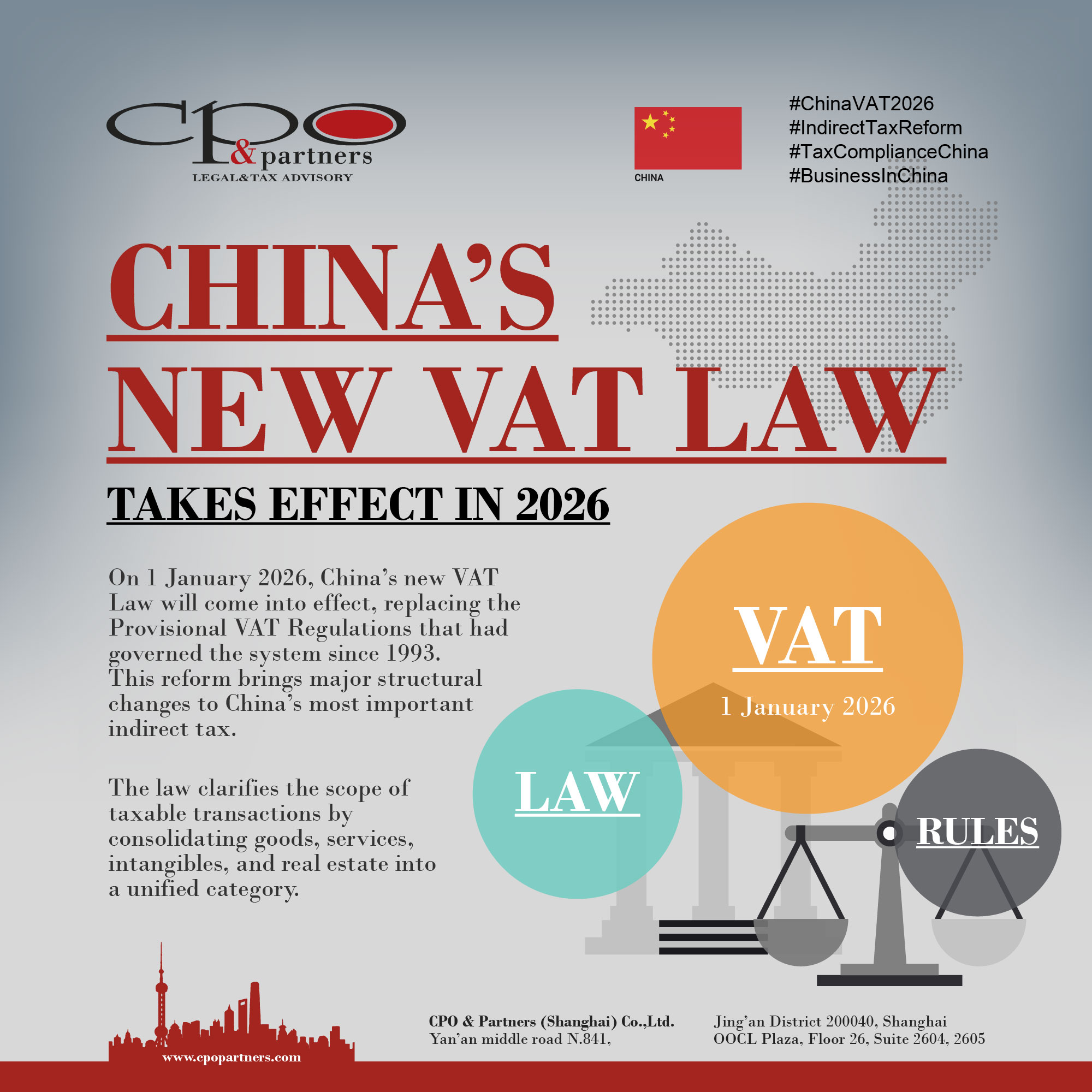
On 1 January 2026, China’s new VAT Law will come into effect, replacing the Provisional VAT Regulations that had governed the system since 1993. This reform brings major structural changes to China’s most important indirect tax.
The law clarifies the scope of taxable transactions by consolidating goods, services, intangibles, and real estate into a unified category. The previous distinction for “labor services” has been removed and is now treated as part of “services.”
Provisions on deemed sales have been updated. Self-produced or commissioned goods provided for non-business use, such as employee benefits, will now be taxable. Free intra-group services between businesses will no longer be subject to VAT.
Rules on input VAT deductions have also changed. Loan service VAT may become deductible; however, this depends on implementing rules to be issued by the State Council.
For small-scale taxpayers, a simplified structure introduces a unified 3% rate, replacing the previous 3% and 5% tiers. Some exceptions may apply, for example in real estate leasing.
The law also introduces anti-avoidance rules allowing tax authorities to adjust valuations in non-monetary or related-party transactions. In addition, taxpayers may either carry forward excess input VAT or apply for a refund, improving liquidity.
The CBAM compliance enters a new phase