标签: GlobalRegulations

Il-dazio-da-3-euro-sui-pacchi-low-value

The €3 Duty on Low-Value Parcels: Will the tightening measures effective?

Il-dazio-da-3-euro-sui-pacchi-low-value

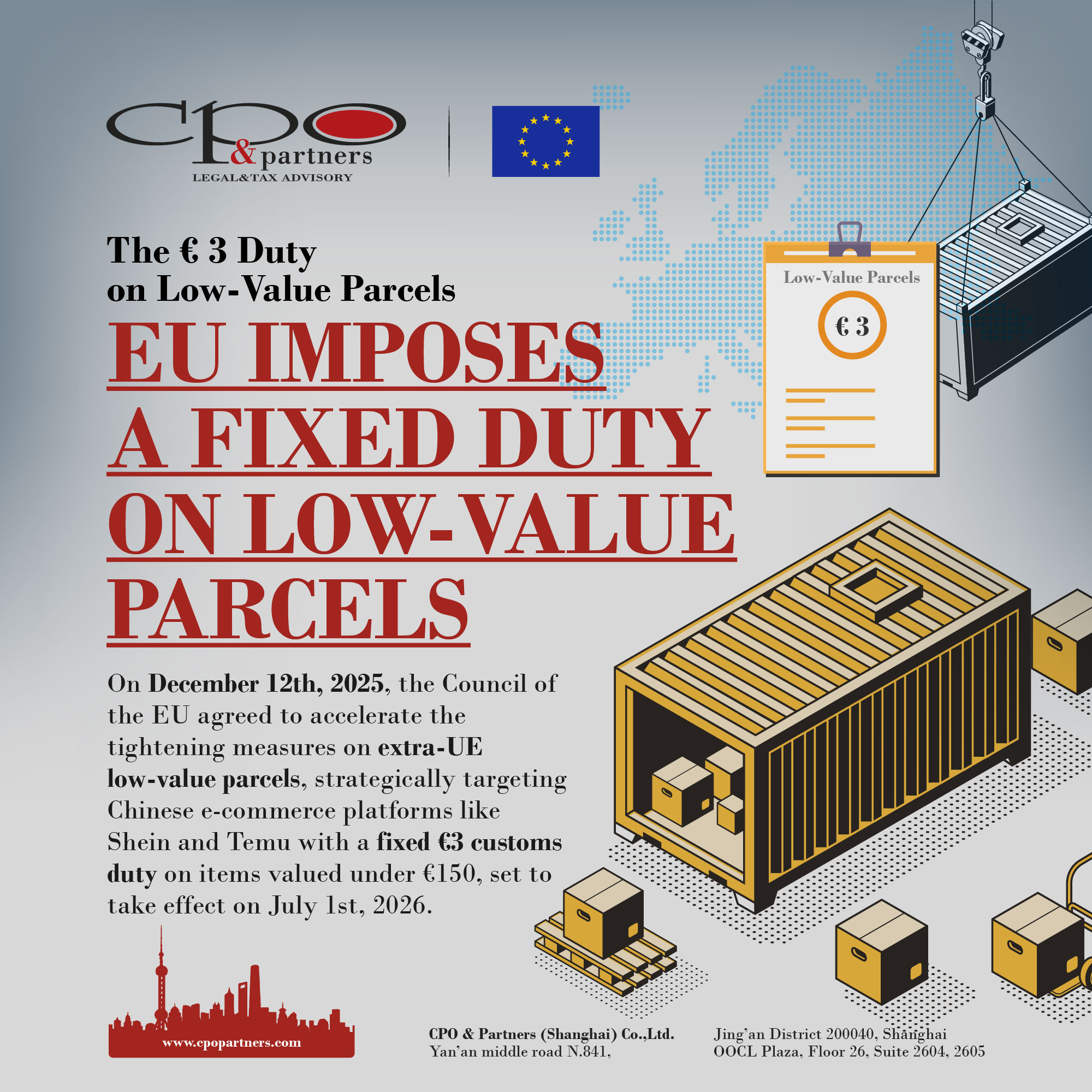
On December 12th, 2025, the Council of the EU agreed to accelerate the tightening measures on extra-UE low-value parcels, strategically targeting Chinese e-commerce platforms like Shein and Temu with a fixed €3 customs duty on items valued under €150, set to take effect on July 1st, 2026.

📦 The idea is to stop the growing wave of cheap goods that enter Europe without customs duties, putting local businesses at a disadvantage. However, a recent unilateral action by Italy serves as a warning of potential unintended consequences.

On January 1st, 2026, Italy introduced a €2 tax on parcels valued below €150 arriving from non-EU countries. The result was immediate: e-commerce companies simply rerouted shipments through Poland, Germany, and other EU member states. Hence, Italian logistics hubs might lose substantial revenues, while consumers continue receiving the same products with minimal delay.

⚠️ The Italian experience underscores a critical vulnerability in the EU’s new plan. Without a perfectly synchronized and harmonized enforcement strategy across all 27 member states, the €3 duty risks becoming a mere redirect, rather than a reduction, of the Chinese e-commerce volume. The measure is a first step toward fair competition, but its success depends on unified implementation.

Cooperazione digitale UE–Cina

Forefront of EU–China digital cooperation

Cooperazione digitale UE–Cina

CPO & Partners is delighted to share its active participation in the prestigious European Union Chamber of Commerce in China Site Tour at China Mobile Shanghai Industrial Research Institute and Shanghai Mobile New-Quality Productivity Exhibition Hall.

🚀 This event showcased cutting-edge innovations in 5G, AI, big data, IoT, and new-quality productivity, with demonstrations of Baidou Satellite guidance, drone navigation, and smart transportation.

🎤 Keynotes on cross-border compliance, cloud-network integration, and data pathways by China Mobile experts provided invaluable insights for Sino-European digital collaboration.

🤝 Our presence underscores our commitment to bridging Italy-China business, leveraging nearly 20 years in Shanghai to explore compliant digital infrastructure opportunities for our clients.

2026-02-03-Focus--Decreto-Legislativo-30-dicembre-2025,-n.-211

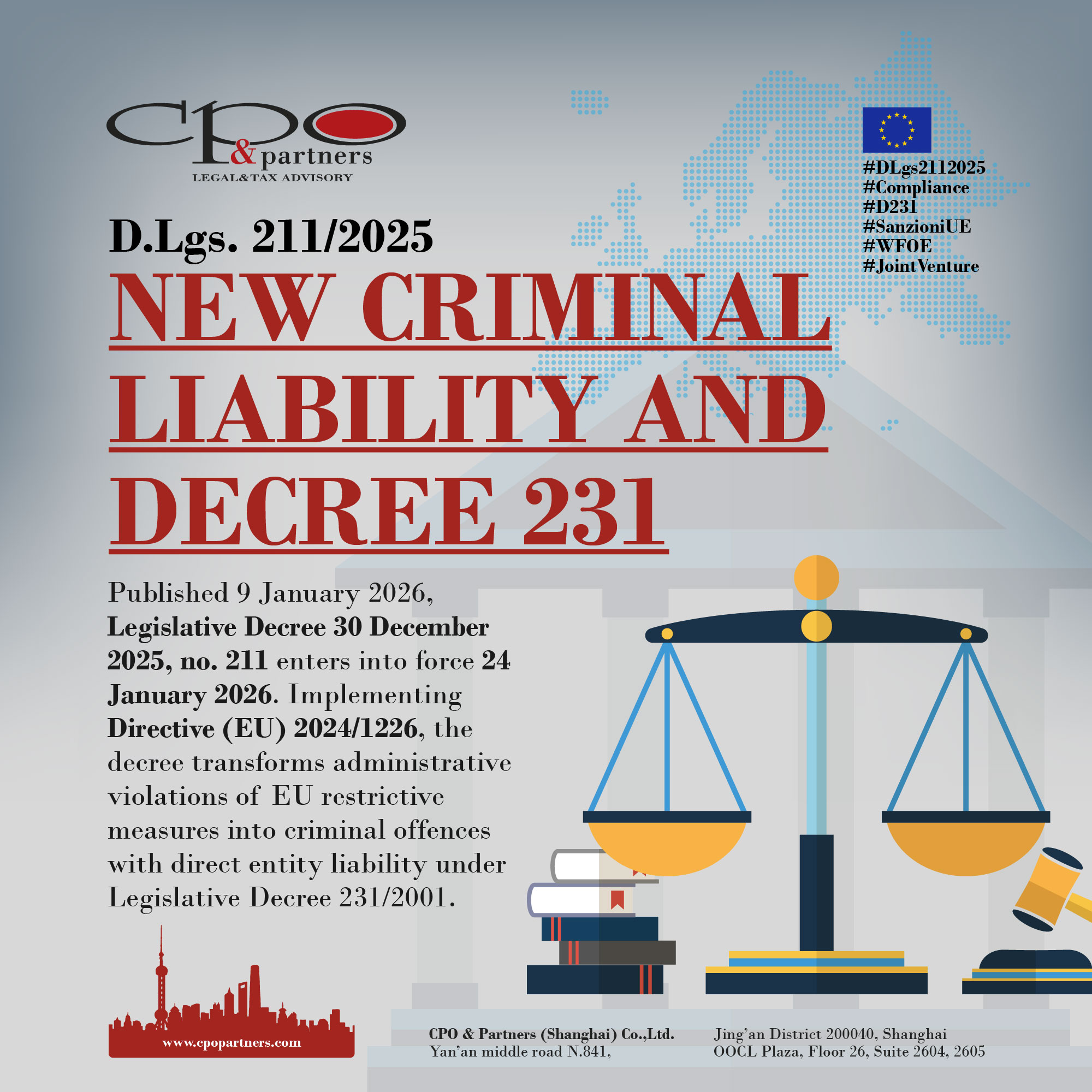
D.Lgs. 211/2025 – New Criminal Liability and Decree 231

2026-02-03-Focus--Decreto-Legislativo-30-dicembre-2025,-n.-211

Published 9 January 2026, Legislative Decree 30 December 2025, no. 211 enters into force 24 January 2026. Implementing Directive (EU) 2024/1226, the decree transforms administrative violations of EU restrictive measures into criminal offences with direct entity liability under Legislative Decree 231/2001.

  • New Criminal Code offences (Articles 275-bis et seq.) target asset freezes, making funds available to designated entities, authorisation breaches, and gross negligence in dual-use classification. Extraterritorial reach covers Italian nationals abroad.
  • Entity liability (Article 25-octies.2): 1-5% global turnover sanctions (min. €3-40M), 1-6 year disqualifications. Exemption requires updated 231 Models with CONSIS screening and dual-use protocols.
  • Italian groups with China WFOEs, joint ventures and minority stakes: Chinese supply chains circumvent Russia sanctions (19 EU packages). Parent companies risk liability for subsidiary/participated entity violations if exercising direction or deriving benefit.

Actions: CONSIS screening, 231 Model update, training for China operations.

Catalogo-delle-Industrie-Favorite-agli-Investimenti-Esteri-2025

China releases the 2025 Encouraged Catalogue for Foreign Investment

Catalogo-delle-Industrie-Favorite-agli-Investimenti-Esteri-2025

On December 24, 2025, China released the Catalogue of Encouraged Industries for Foreign Investment 2025, effective February 1, 2026, updating the list of sectors and activities eligible for preferential treatment, streamlined procedures, and operational advantages.

Compared to the previous version, the new Catalogue shows a broader scope – with 200+ new items and 300+ revisions – and a more targeted focus on:

  • Advanced manufacturing, with items from terminal products and components to raw materials;
  • Green technologies and modern services, such as lifestyle, consumer-facing, and digitalized service industries;
  • Additional incentives for central, western, northeastern regions (underdeveloped areas), and Hainan.

Four preferential policies:

  1. Customs duty exemptions for imported self-use equipment;
  2. Preferential industrial land access – reductions down to 70% and more flexibility;
  3. Reduced CIT (15%) for eligible projects located in western China and Hainan;
  4. Tax credits for profits reinvestment into National Catalogue’s projects.

This update confirms China’s intention to attract foreign investment, especially when aligned with its high-quality growth, innovation, and regional development goals, offering a key instrument for recalibrating China and Far East investment strategies.


Pdf Source (Chinese language)

https://www.ndrc.gov.cn/xxgk/zcfb/fzggwl/202512/P020251224301773999332.pdf

China-New-Government-Procurement-Standards-2026

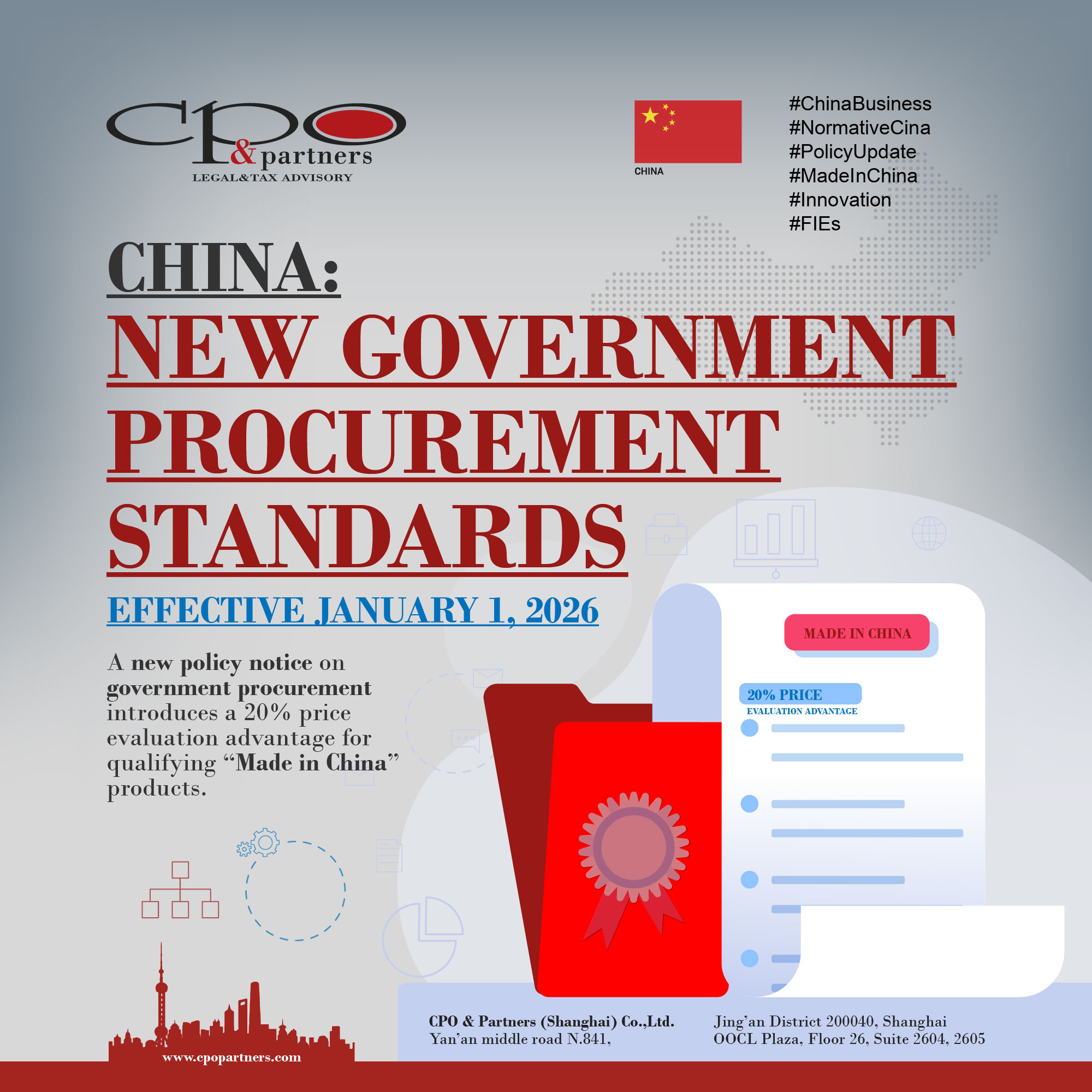
China: New Government Procurement Standards – Effective January 1, 2026

China-New-Government-Procurement-Standards-2026

A new policy notice on government procurement introduces a 20% price evaluation advantage for qualifying “Made in China” products – a move designated to strengthen domestic manufacturing while ensuring foreign-invested enterprises (FIEs) can still participate on equal footing.

Key points:

  • Domestic products meeting specific transformation and cost criteria can enjoy a 20% bid advantage.
  • Mixed procurement packages qualify as “Made in China” if 80% or more of the products are domestically produced.
  • Stricter requirements apply to high-tech and security-sensitive components.
  • A five-year rollout period followed by a 3-5-year transition ensures smooth implementation.

This policy underscores China’s push for high-quality industrial development, local innovation, and balanced global participation in its procurement ecosystem.

Customs-Duties-The-EU-Closes-Low-Value-Parcels-Loophole

Customs Duties: The EU Closes Low-Value Parcels Loophole

Customs-Duties-The-EU-Closes-Low-Value-Parcels-Loophole

On November 13th, 2025, the European Commission agreed to eliminate the €150 customs duty relief threshold and potentially introduce “handling fees” on e-commerce packages as of 2026.

Given the evolution of the e-commerce model, this exemption is no longer justified and creates unfair competition. This initiative directly addresses the sharp rise in low-value B2C parcels shipped from non-EU platforms to EU consumers.

This measure aligns with the VAT framework already in force since 2021, which abolished the €22 VAT relief threshold, applying VAT on all commercial goods imported into the EU from third countries and requiring an import declaration.

The removal of the customs duty exemption threshold means that all goods, regardless of their value, will no longer be exempt from customs duties – ensuring fairer conditions between wholesale and retail importers.

Until mid-2028, a temporary system will be in place to facilitate duty calculation on low-value parcels; afterwards. the EU Customs Data Hub will centralize the entire customs processing.

This agreement marks a pivotal step in the modernization of EU customs procedures, paving the way for a more streamlined, transparent, and equitable system.


To receive the PDF with details and insights on the topic “CBAM – Definitive Phase 2026,” please subscribe to our newsletter by clicking on the following link:

https://www.cpopartners.com/cpo-newsletter-customs-duties/


Follow our LinkedIn page to stay updated and receive all the latest news from the world of China and Southeast Asia:

https://www.linkedin.com/company/cpo-partners

newsletter_2025-11-19-CBAM-Fase-Definitiva-2026

CBAM – Final Phase 2026

newsletter_2025-11-19-CBAM-Fase-Definitiva-2026

CBAM – Final Phase: Sustainability as Market-Access Requirement

Starting January 1st, 2026, the Carbon Border Adjustment Mechanism (CBAM) will enter into full force, introducing a carbon cost on imports with high embedded emissions – including aluminum, cement, electricity, fertilizers, iron and steel – to support more sustainable global trade.

The New Regulation (EU) 2025/2083 launches the definitive phase of CBAM, fully integrating climate policy into international trade.

Importers and their indirect customs representatives will be required to obtain the status of authorized CBAM declarant and operate through the EU’s digital CBAM Registry.

The annual CBAM declaration must be submitted by September 30th of the year following the imports (first deadline: 2027), while the purchase of CBAM certificates to offset emissions will begin in 2027 for emissions related to 2026.

Updates:

  • A de minimis threshold – 50 tons per year for CBAM goods, easing the burden on smaller firms.
  • Reduction of the mandatory certificate holding requirement from 80% to 50% of quarterly emissions.
  • Possibility for authorized declarants to delegate the CBAM declaration to a third party.

What to do?

  • Check whether exempt due to the de minimis
  • Apply for CBAM authorization before the end of 2025 (temporary waiver until March 31st, 2026).
  • Set up robust systems for collecting data on embedded emissions in imported goods.


To receive the PDF with details and insights on the topic “CBAM – Definitive Phase 2026,” please subscribe to our newsletter by clicking on the following link:

https://www.cpopartners.com/cpo-newsletter-cbam/


Follow our LinkedIn page to stay updated and receive all the latest news from the world of China and Southeast Asia

https://www.linkedin.com/company/cpo-partners

2025-11-13-China-postpones-the-new-export-controls-on-REEs-announced-on-October-9-2025

China postpones the new export controls on Rare Earths

2025-11-13-China-postpones-the-new-export-controls-on-REEs-announced-on-October-9-2025

China postpones the new export controls on Rare Earths announced on October 9th, 2025

After introducing the first export controls on 7 Rare Earths (REEs) and their derivatives on April 4th, 2025, China announced a second round of restrictions on October 9th.

The new measures included export controls on an additional 5 REEs as well as a new extraterritorial provision, which – starting from December 1, 2025 – would have required a dual-use item export license issued by MOFCOM even for products manufactured outside China and destined for a third country, if containing raw materials or technologies of Chinese origin. The impact? Potential shipments disruptions, further delays, and significant administrative bottlenecks.

Following preliminary trade talks between Presidents Xi and Trump during the ASEAN Summit on October 30th, China agreed to suspend the new restrictions for one year. Moreover, during a closed-door meeting between Chinese and EU representatives in Brussels, it was declared – though not yet officially – that the suspension would also apply to the EU.

On November 7th, 2025, China formally confirmed the suspension of the new REEs export control measures until November 10th, 2026. However, the controls introduced on April 4th, 2025, remain in full force.

China-Labor-Compliance-and-High-Temperature-Allowance

China Labor Compliance and High-Temperature Allowance

China-Labor-Compliance-and-High-Temperature-Allowance

China Labor Compliance and High-Temperature Allowance

With increasing extreme summer temperatures in China, employers must implement measures to protect employees from heat-related health risks, including both physical safeguards and compliance with high-temperature allowance regulations. High-heat labor protection is governed by national legislation and local implementation rules, which determine allowance amounts, calculation methods, and applicable months for each province.
The law provides for a cash allowance based on specific heat conditions: for outdoor work a temperature equal or higher than 35°C, for indoor work a temperature equal or higher than 33°C with insufficient cooling. The cash allowance cannot be substituted with benefits like cold drinks, is subject to personal income tax, and is eligible for all staff, including interns, dispatch, temporary, hourly workers and foreigners under Chinese labor contracts.
Other employer duties include rescheduling working hours to avoid peak heat, providing cooling and protective measures (cooling devices, rest areas, cold water, PPE) and planning training sessions and health checks. Summer inspections by labor bureaus may occur and violations may lead to fines, retroactive worker compensation, and reputational damage.
Il piano di Shanghai per migliorare il sistema di rimborso fiscale ai visitatori in partenza

Shanghai’s Plan to Improve the Tax Refund Environment for Departing Visitors

Il piano di Shanghai per migliorare il sistema di rimborso fiscale ai visitatori in partenza

Shanghai’s Plan to Improve the Tax Refund Environment for Departing Visitors

On July 3, 2025, the Shanghai Municipal Commission of Commerce, together with five departments, launched a 2025–2027 Action Plan to upgrade its departure tax refund system. The new policy allows foreign tourists to receive VAT refunds directly in-store through the “Refund-upon-Purchase” system, replacing the previous departure-based tax refund system. Foreign tourists shopping at eligible stores need to complete a refund agreement and credit card pre-authorization to receive an instant refund. At departure, they present goods, receipts, and ID to customs for verification. Lastly, a refund agency at the port finalizes the process.


In addition, the minimum spending threshold was reduced from ¥500 to ¥200 per store per day, while the daily refund cap rose to ¥20,000. Moreover, to encourage merchant adoption, Shanghai offers up to 50% equipment subsidies, cash incentives (¥5,000–¥10,000), and fee waivers for up to two years. Moreover, registration has been simplified, and credit requirements relaxed to include Grade M taxpayers.


Shanghai plans to boost over 80% of tax-refund stores to support instant refunds via card or mobile payment. Furthermore, it aims to expand to 3,000+ stores and 10,000 service points by 2027, with smart terminals, sealed-bag packaging, and multilingual tools improving efficiency.