2025-11-13-China-postpones-the-new-export-controls-on-REEs-announced-on-October-9-2025

China postpones the new export controls on Rare Earths

2025-11-13-China-postpones-the-new-export-controls-on-REEs-announced-on-October-9-2025

China postpones the new export controls on Rare Earths announced on October 9th, 2025

After introducing the first export controls on 7 Rare Earths (REEs) and their derivatives on April 4th, 2025, China announced a second round of restrictions on October 9th.

The new measures included export controls on an additional 5 REEs as well as a new extraterritorial provision, which – starting from December 1, 2025 – would have required a dual-use item export license issued by MOFCOM even for products manufactured outside China and destined for a third country, if containing raw materials or technologies of Chinese origin. The impact? Potential shipments disruptions, further delays, and significant administrative bottlenecks.

Following preliminary trade talks between Presidents Xi and Trump during the ASEAN Summit on October 30th, China agreed to suspend the new restrictions for one year. Moreover, during a closed-door meeting between Chinese and EU representatives in Brussels, it was declared – though not yet officially – that the suspension would also apply to the EU.

On November 7th, 2025, China formally confirmed the suspension of the new REEs export control measures until November 10th, 2026. However, the controls introduced on April 4th, 2025, remain in full force.

China-Labor-Compliance-and-High-Temperature-Allowance

China Labor Compliance and High-Temperature Allowance

China-Labor-Compliance-and-High-Temperature-Allowance

China Labor Compliance and High-Temperature Allowance

With increasing extreme summer temperatures in China, employers must implement measures to protect employees from heat-related health risks, including both physical safeguards and compliance with high-temperature allowance regulations. High-heat labor protection is governed by national legislation and local implementation rules, which determine allowance amounts, calculation methods, and applicable months for each province.
The law provides for a cash allowance based on specific heat conditions: for outdoor work a temperature equal or higher than 35°C, for indoor work a temperature equal or higher than 33°C with insufficient cooling. The cash allowance cannot be substituted with benefits like cold drinks, is subject to personal income tax, and is eligible for all staff, including interns, dispatch, temporary, hourly workers and foreigners under Chinese labor contracts.
Other employer duties include rescheduling working hours to avoid peak heat, providing cooling and protective measures (cooling devices, rest areas, cold water, PPE) and planning training sessions and health checks. Summer inspections by labor bureaus may occur and violations may lead to fines, retroactive worker compensation, and reputational damage.
Il piano di Shanghai per migliorare il sistema di rimborso fiscale ai visitatori in partenza

Shanghai’s Plan to Improve the Tax Refund Environment for Departing Visitors

Il piano di Shanghai per migliorare il sistema di rimborso fiscale ai visitatori in partenza

Shanghai’s Plan to Improve the Tax Refund Environment for Departing Visitors

On July 3, 2025, the Shanghai Municipal Commission of Commerce, together with five departments, launched a 2025–2027 Action Plan to upgrade its departure tax refund system. The new policy allows foreign tourists to receive VAT refunds directly in-store through the “Refund-upon-Purchase” system, replacing the previous departure-based tax refund system. Foreign tourists shopping at eligible stores need to complete a refund agreement and credit card pre-authorization to receive an instant refund. At departure, they present goods, receipts, and ID to customs for verification. Lastly, a refund agency at the port finalizes the process.


In addition, the minimum spending threshold was reduced from ¥500 to ¥200 per store per day, while the daily refund cap rose to ¥20,000. Moreover, to encourage merchant adoption, Shanghai offers up to 50% equipment subsidies, cash incentives (¥5,000–¥10,000), and fee waivers for up to two years. Moreover, registration has been simplified, and credit requirements relaxed to include Grade M taxpayers.


Shanghai plans to boost over 80% of tax-refund stores to support instant refunds via card or mobile payment. Furthermore, it aims to expand to 3,000+ stores and 10,000 service points by 2027, with smart terminals, sealed-bag packaging, and multilingual tools improving efficiency.

Announcement-on-Tax-Credit-Policy-for-Foreign-Investors'-Direct-Investment

China 2025–2028 Tax Credit Policy

Announcement-on-Tax-Credit-Policy-for-Foreign-Investors'-Direct-Investment

China 2025–2028 Tax Credit Policy for Foreign Investors’ Reinvestment of Profits

On 27 June 2025, China’s Ministry of Finance, State Taxation Administration, and Ministry of Commerce jointly issued Announcement [2025] No. 2, regarding a 10% enterprise income tax credit that can be claimed by eligible foreign investors who reinvest profits (e.g., dividends, interest, royalties or other kind of income) in specified sectors. The policy applies from 1 January 2025 to 31 December 2028, with retroactive eligibility for qualifying investments made after 1 January 2025.
To qualify, reinvestments must be in industries listed in the Encouraged Industries Catalogue and take the form of capital increases, new enterprises, or equity acquisitions from unrelated, non-listed parties. Among those Encouraged Industries are agriculture, mining, manufacturing, construction, transport, IT, finance, R&D and others. The holding period of investment must be at least five years, and investments must be paid directly from the distributing enterprise to the investee. In addition, early withdrawal triggers tax repayment and proportional claw back of tax credits, and compliance is managed through the Ministry of Commerce’s Unified Platform.
China’s new VAT Law takes effect in 2026

China’s new VAT Law takes effect in 2026

China’s new VAT Law takes effect in 2026

China’s new VAT Law takes effect in 2026

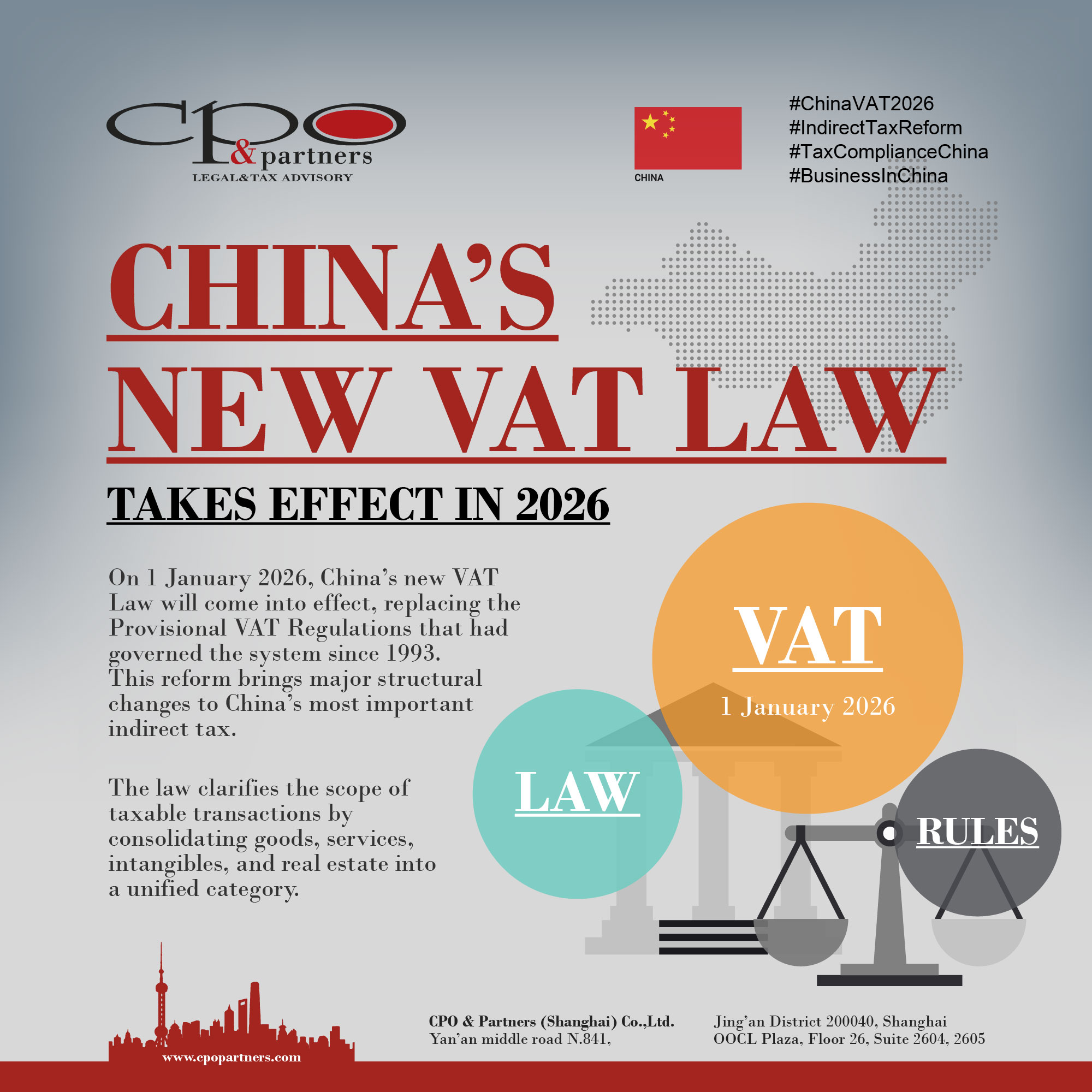
On 1 January 2026, China’s new VAT Law will come into effect, replacing the Provisional VAT Regulations that had governed the system since 1993. This reform brings major structural changes to China’s most important indirect tax.
The law clarifies the scope of taxable transactions by consolidating goods, services, intangibles, and real estate into a unified category. The previous distinction for “labor services” has been removed and is now treated as part of “services.”
Provisions on deemed sales have been updated. Self-produced or commissioned goods provided for non-business use, such as employee benefits, will now be taxable. Free intra-group services between businesses will no longer be subject to VAT.
Rules on input VAT deductions have also changed. Loan service VAT may become deductible; however, this depends on implementing rules to be issued by the State Council.
For small-scale taxpayers, a simplified structure introduces a unified 3% rate, replacing the previous 3% and 5% tiers. Some exceptions may apply, for example in real estate leasing.
The law also introduces anti-avoidance rules allowing tax authorities to adjust valuations in non-monetary or related-party transactions. In addition, taxpayers may either carry forward excess input VAT or apply for a refund, improving liquidity.
2025-03-19--China's-Green-Push-Shanghai-2025-Vehicle-Replacement

China’s Green Push: Shanghai 2025 Vehicle Replacement and New Energy

2025-03-19--China's-Green-Push-Shanghai-2025-Vehicle-Replacement

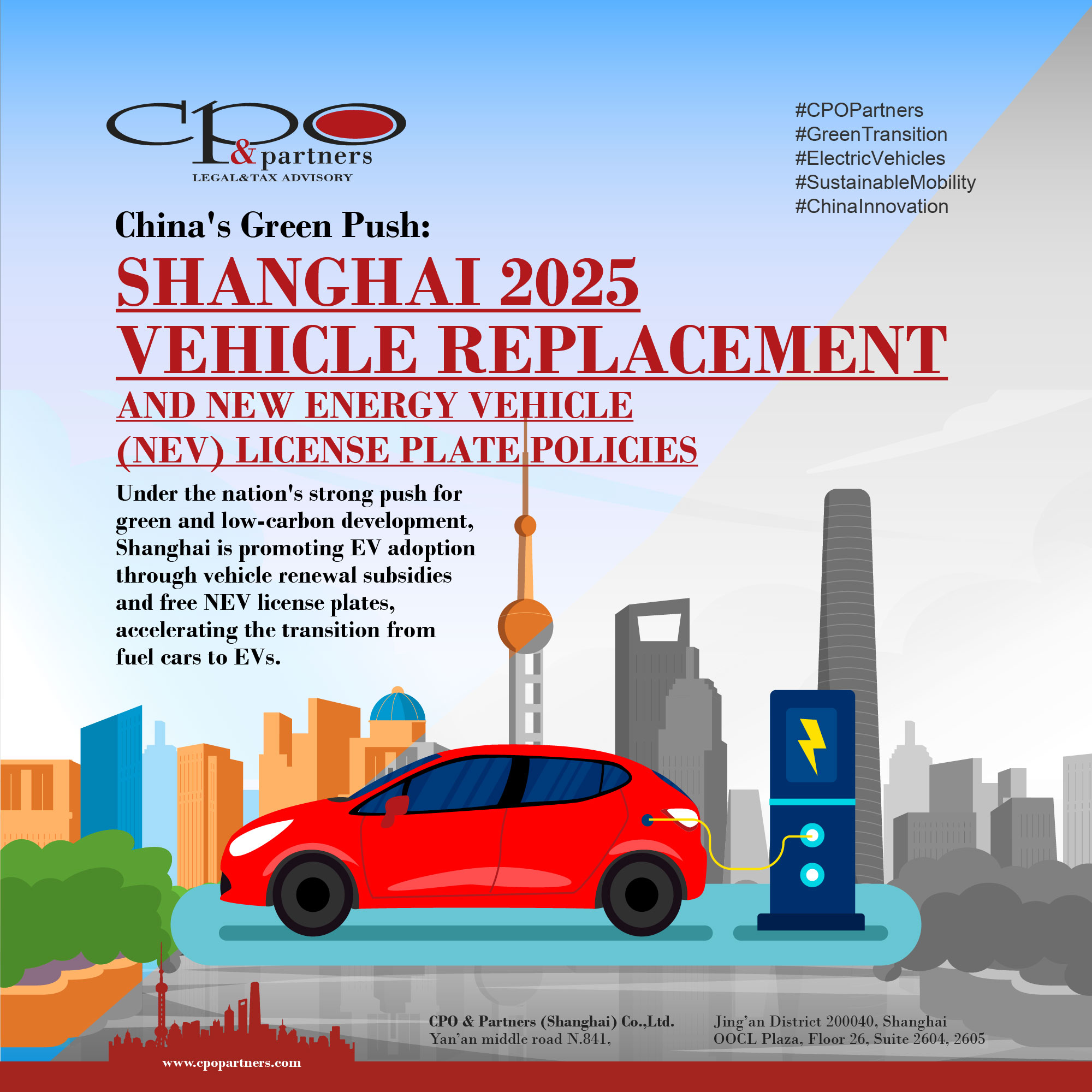
Under the nation’s strong push for green and low-carbon development, Shanghai is promoting EV adoption through vehicle renewal subsidies and free NEV license plates, accelerating the transition from fuel cars to EVs.


I. Shanghai Vehicle Replacement Policies

In terms of green initiatives for the replacement of old fuel vehicles, in February several Shanghai Municipal Commissions and Bureaus issued the Notice No. 20 [2025] “Implementation Rules for the National Vehicle Scrapping and Renewal Subsidy Policy for 2025”, taking effect upon issuance and valid until 31 March 2026.

The Rules provide for a one-time fixed subsidy for all eligible individual consumers who, between 1 January and 31 December 2025, decide to scrap gasoline passenger vehicles or new energy passenger vehicles (electric vehicles but registered before 31 December 2018) to buy new energy passenger vehicles listed in a specific Catalog issued by the Ministry of Industry and Information Technology. The consumers will also be able to purchase fuel passenger vehicles with set limitations on the engine displacement. The subsidy will be equal to Rmb 20.000 for the purchase of new energy vehicles, Rmb 15.000 for the purchase of fuel vehicles that are complaint with the limitations imposed.


II. Shanghai New Energy Vehicle License Plate Policies

  • Shanghai Green License Plate – Exclusive for Pure Electric Vehicles and Fuel Cell Vehicles

According to the “2025 Shanghai Measures to Encourage the Purchase and Use of NEVs”, especially for non-local residents holding a Shanghai Residence Permit, they now only need to have paid social security or personal income tax for 36 months (previously 48 months) to qualify for a free green (NEV) license plate. For applying organizations, they need to have more than five employees enrolled in Shanghai’s social security system or have continuously paid taxes in Shanghai for at least one year before applying. From the application to the final license plate issuance, the process usually takes about half a month.


  • Shanghai Blue License Plate – Auction for Traditional Fuel Vehicles

Individuals with Shanghai household registration or non-local residents holding a Shanghai Residence Permit who have continuously paid social security or personal income tax for the past six months, as well as legally registered companies, can apply for the auction of Shanghai blue license plates through online or offline channels by completing the required procedures, including bidding registration and deposit payment. Recent data shows that the average winning bid for an individual blue license plate is approximately Rmb 93,600, while for organizations, it ranges from Rmb 120,000 to Rmb 160,000. The entire process, from the application to the final license plate issuance, may take 2 to 6 months to complete.


III. Green and Blue License Plates Outside Shanghai

Outside Shanghai, big cities like Beijing, Guangzhou and Shenzhen present a similar scenario in terms of waiting time to obtain a NEV green license plate, with an estimate time of around 1-2 weeks. As for the requirements, the key difference is the existence of a quota system, whose process is however more streamlined compared to the quota system for blue plates. Traditional fuel vehicle blue plates in these three cities are managed through a lottery system or a hybrid system of auctions and lotteries. In the capital city, the chances of obtaining the plate are quite low, 0.2% in 2023, and the waiting period can be of several years. As for the hybrid system in Guangzhou and Shenzhen, the average auction price is in the range of Rmb 30,000 to Rmb 50,000, with a waiting period varying from a few months to over a year.

In China, certain cities may impose temporary or permanent limitations for vehicles with non-local license plates. For example, in order to reduce traffic and pollution, in Shanghai drivers with plates issued in other cities are restricted from using specific elevated roads during peak hours, and an additional fee must be paid to use certain expressways. However, looking at a broader perspective, there are not significant restrictions in the country for driving with a non-local car plate.