China-New-Government-Procurement-Standards-2026

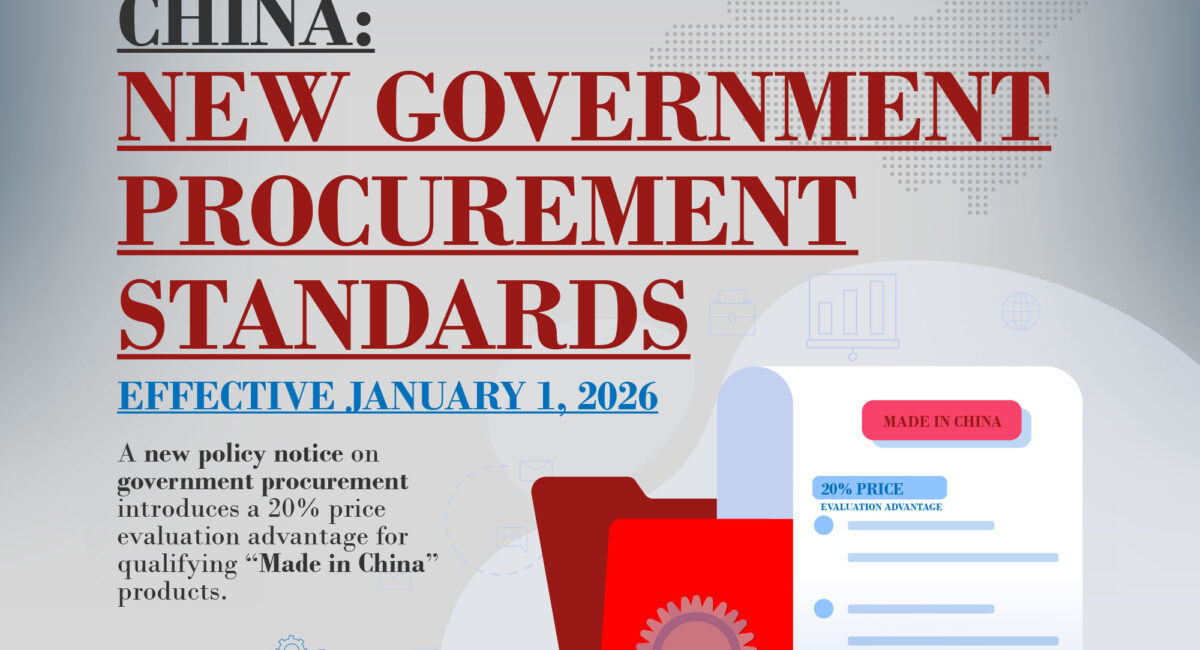
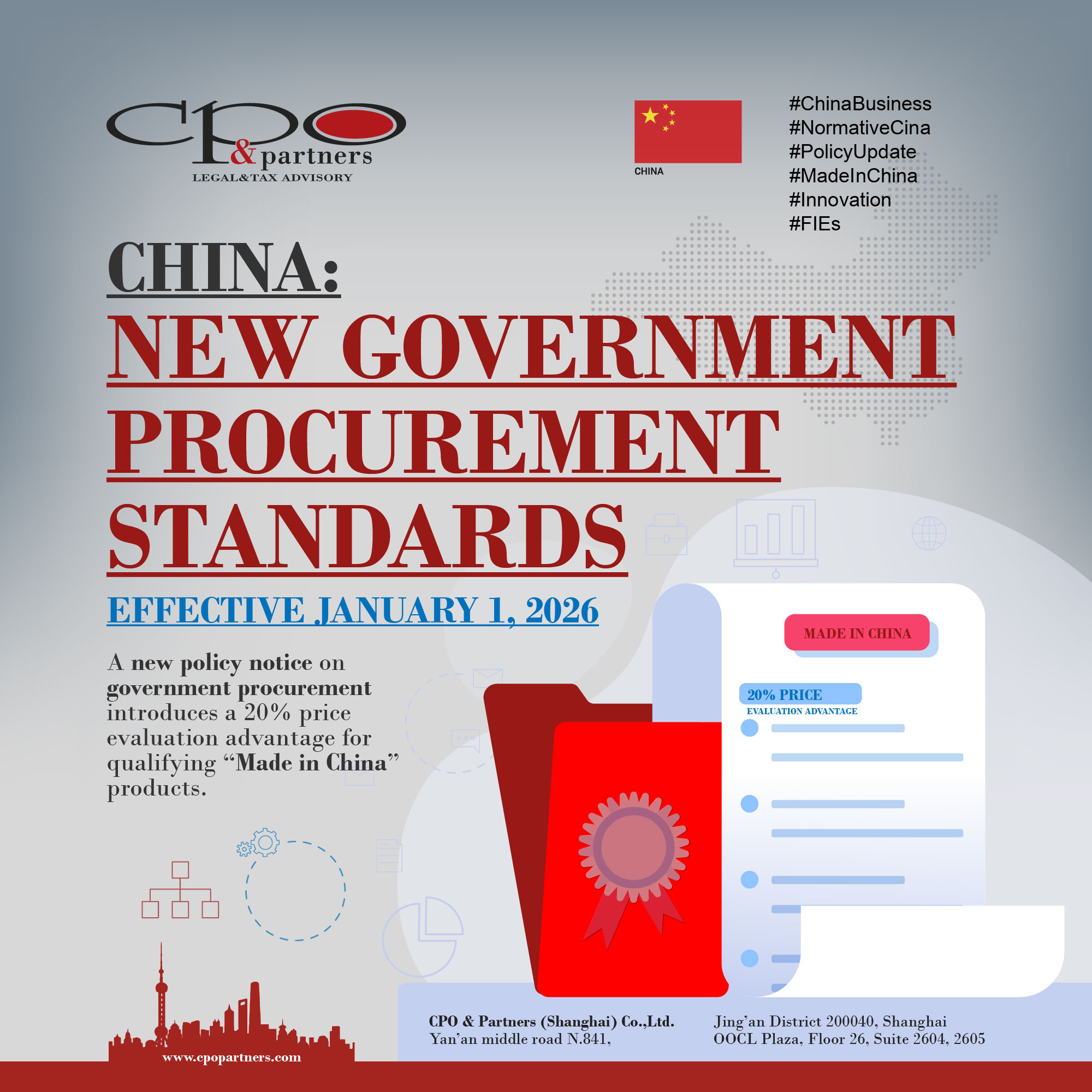
China: New Government Procurement Standards – Effective January 1, 2026

China-New-Government-Procurement-Standards-2026

A new policy notice on government procurement introduces a 20% price evaluation advantage for qualifying “Made in China” products – a move designated to strengthen domestic manufacturing while ensuring foreign-invested enterprises (FIEs) can still participate on equal footing.

Key points:

  • Domestic products meeting specific transformation and cost criteria can enjoy a 20% bid advantage.
  • Mixed procurement packages qualify as “Made in China” if 80% or more of the products are domestically produced.
  • Stricter requirements apply to high-tech and security-sensitive components.
  • A five-year rollout period followed by a 3-5-year transition ensures smooth implementation.

This policy underscores China’s push for high-quality industrial development, local innovation, and balanced global participation in its procurement ecosystem.

Il piano di Shanghai per migliorare il sistema di rimborso fiscale ai visitatori in partenza

Shanghai’s Plan to Improve the Tax Refund Environment for Departing Visitors

Il piano di Shanghai per migliorare il sistema di rimborso fiscale ai visitatori in partenza

Shanghai’s Plan to Improve the Tax Refund Environment for Departing Visitors

On July 3, 2025, the Shanghai Municipal Commission of Commerce, together with five departments, launched a 2025–2027 Action Plan to upgrade its departure tax refund system. The new policy allows foreign tourists to receive VAT refunds directly in-store through the “Refund-upon-Purchase” system, replacing the previous departure-based tax refund system. Foreign tourists shopping at eligible stores need to complete a refund agreement and credit card pre-authorization to receive an instant refund. At departure, they present goods, receipts, and ID to customs for verification. Lastly, a refund agency at the port finalizes the process.


In addition, the minimum spending threshold was reduced from ¥500 to ¥200 per store per day, while the daily refund cap rose to ¥20,000. Moreover, to encourage merchant adoption, Shanghai offers up to 50% equipment subsidies, cash incentives (¥5,000–¥10,000), and fee waivers for up to two years. Moreover, registration has been simplified, and credit requirements relaxed to include Grade M taxpayers.


Shanghai plans to boost over 80% of tax-refund stores to support instant refunds via card or mobile payment. Furthermore, it aims to expand to 3,000+ stores and 10,000 service points by 2027, with smart terminals, sealed-bag packaging, and multilingual tools improving efficiency.

Announcement-on-Tax-Credit-Policy-for-Foreign-Investors'-Direct-Investment

China 2025–2028 Tax Credit Policy

Announcement-on-Tax-Credit-Policy-for-Foreign-Investors'-Direct-Investment

China 2025–2028 Tax Credit Policy for Foreign Investors’ Reinvestment of Profits

On 27 June 2025, China’s Ministry of Finance, State Taxation Administration, and Ministry of Commerce jointly issued Announcement [2025] No. 2, regarding a 10% enterprise income tax credit that can be claimed by eligible foreign investors who reinvest profits (e.g., dividends, interest, royalties or other kind of income) in specified sectors. The policy applies from 1 January 2025 to 31 December 2028, with retroactive eligibility for qualifying investments made after 1 January 2025.
To qualify, reinvestments must be in industries listed in the Encouraged Industries Catalogue and take the form of capital increases, new enterprises, or equity acquisitions from unrelated, non-listed parties. Among those Encouraged Industries are agriculture, mining, manufacturing, construction, transport, IT, finance, R&D and others. The holding period of investment must be at least five years, and investments must be paid directly from the distributing enterprise to the investee. In addition, early withdrawal triggers tax repayment and proportional claw back of tax credits, and compliance is managed through the Ministry of Commerce’s Unified Platform.
China’s new VAT Law takes effect in 2026

China’s new VAT Law takes effect in 2026

China’s new VAT Law takes effect in 2026

China’s new VAT Law takes effect in 2026

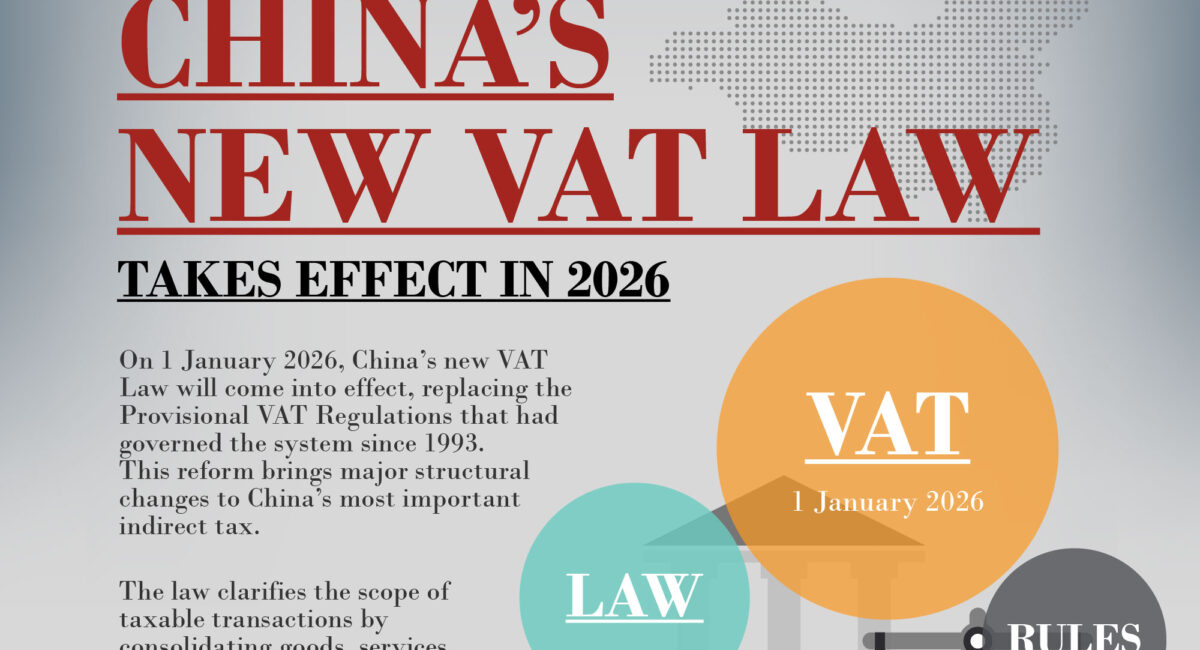
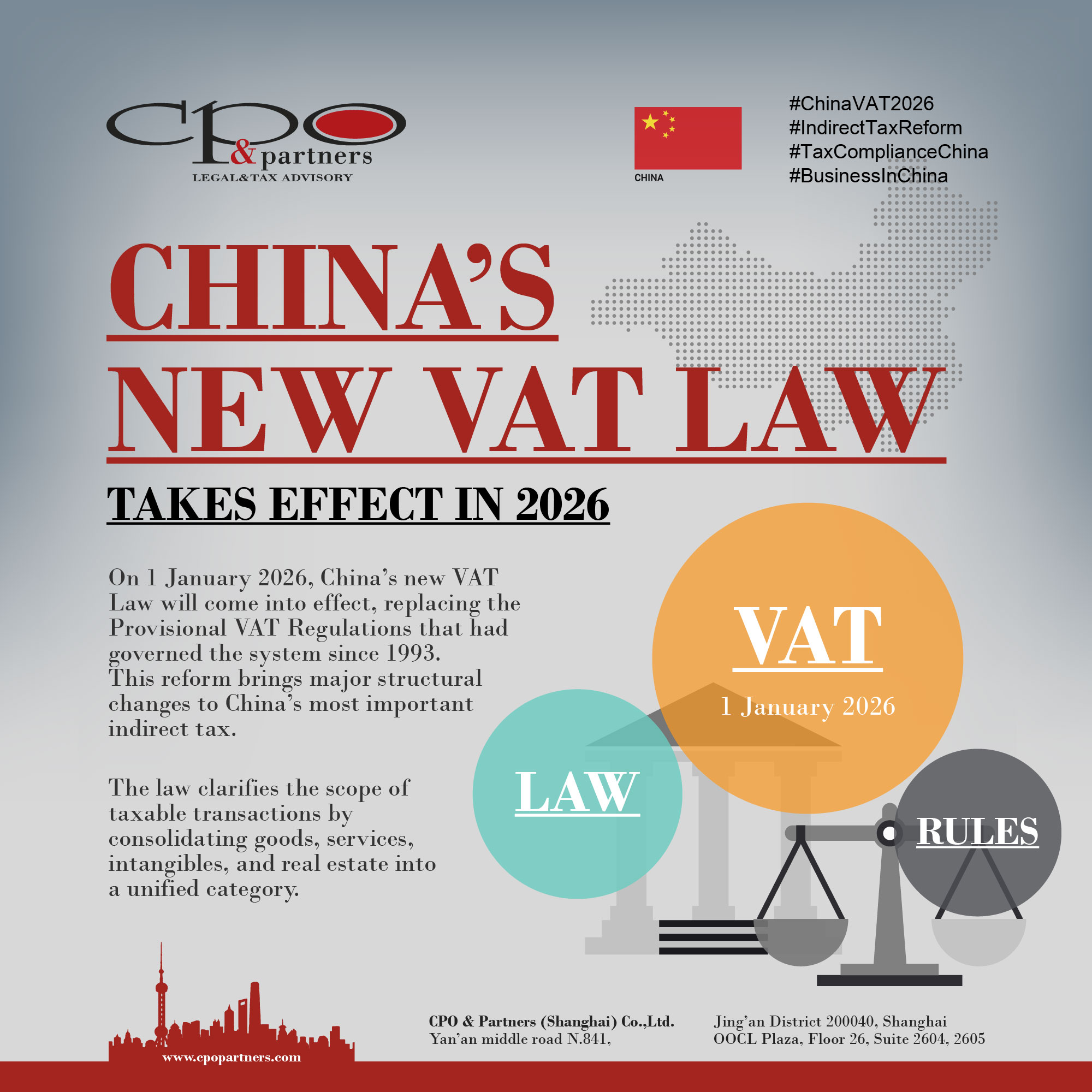
On 1 January 2026, China’s new VAT Law will come into effect, replacing the Provisional VAT Regulations that had governed the system since 1993. This reform brings major structural changes to China’s most important indirect tax.
The law clarifies the scope of taxable transactions by consolidating goods, services, intangibles, and real estate into a unified category. The previous distinction for “labor services” has been removed and is now treated as part of “services.”
Provisions on deemed sales have been updated. Self-produced or commissioned goods provided for non-business use, such as employee benefits, will now be taxable. Free intra-group services between businesses will no longer be subject to VAT.
Rules on input VAT deductions have also changed. Loan service VAT may become deductible; however, this depends on implementing rules to be issued by the State Council.
For small-scale taxpayers, a simplified structure introduces a unified 3% rate, replacing the previous 3% and 5% tiers. Some exceptions may apply, for example in real estate leasing.
The law also introduces anti-avoidance rules allowing tax authorities to adjust valuations in non-monetary or related-party transactions. In addition, taxpayers may either carry forward excess input VAT or apply for a refund, improving liquidity.
Private-Economy-Protection-Law

New legislation for China’s private sector economy

Private-Economy-Protection-Law

New legislation for China’s private sector economy

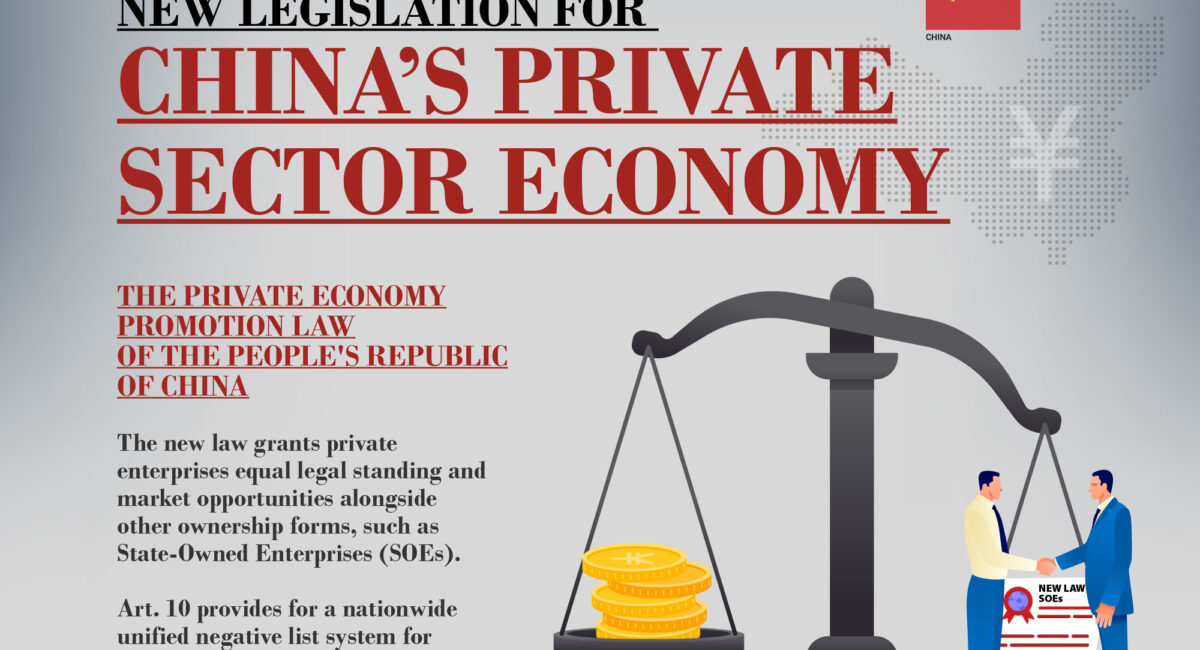
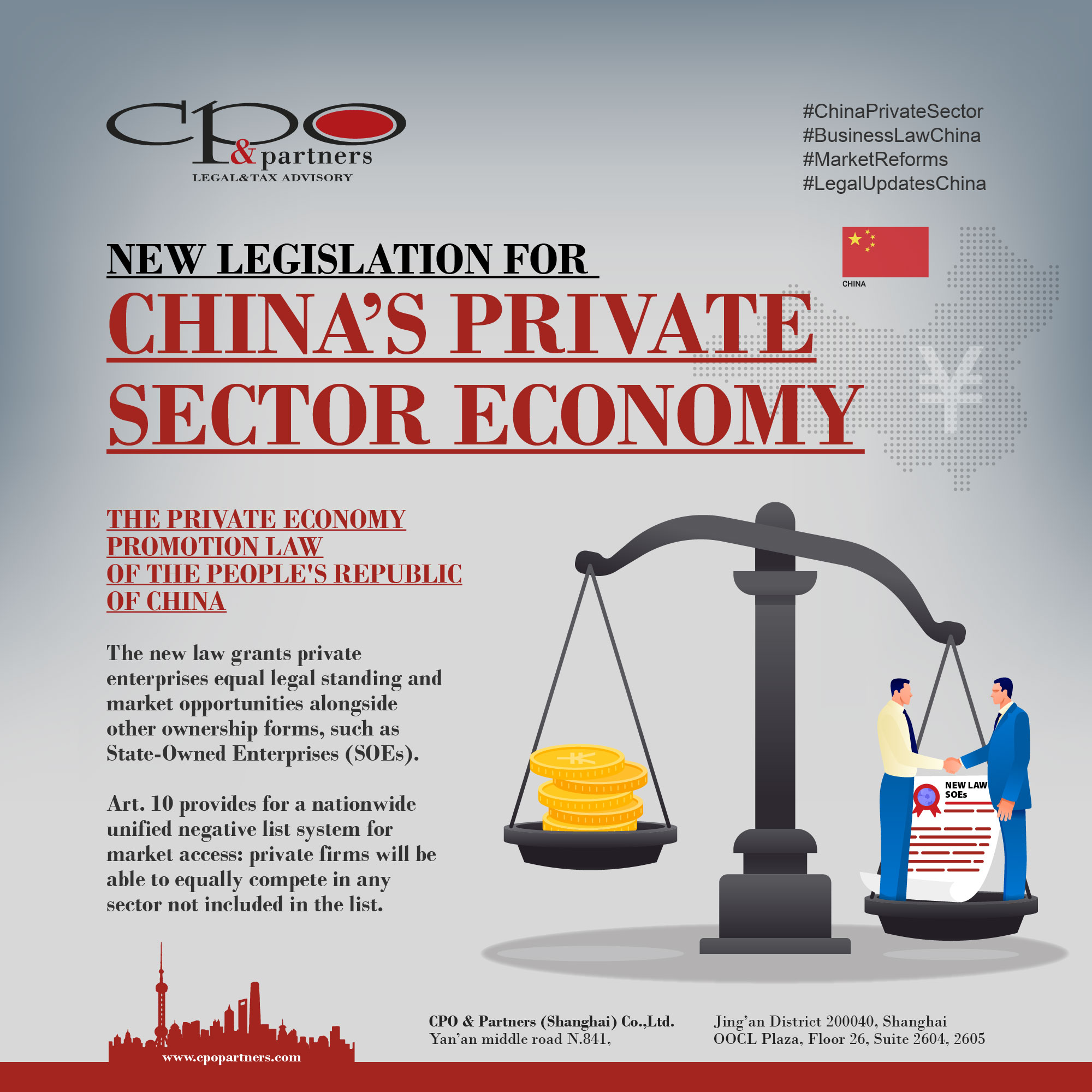
The Private Economy Promotion Law of the People’s Republic of China was adopted by the Standing Committee of the National People’s Congress on 30 April 2025, and took officially effect on 20 May.
The new law grants private enterprises equal legal standing and market opportunities alongside other ownership forms, such as State-Owned Enterprises (SOEs). The legislation acts in favor of fair competition practices for private firms, in terms of access to bidding, procurement etc. For example, Art. 10 provides for a nationwide unified negative list system for market access: private firms will be able to equally compete in any sector not included in the list.
Another important point is related to R&D schemes: private enterprises are encouraged to undertake major national science and technology projects, while entitled to receive from the state greater research infrastructure and data resources. The law also mandates government bodies and SOEs to honor payment obligations on schedule, with penalties for default.
Having faced for long-time discrimination and inequality of treatment compared to SOEs, private firms may find enhanced protection through the new legislation. However, as often occurs in the country, the actual safeguards offered by the law can only be evaluated against future enforcement mechanisms.
Nuove aliquote di rimborso fiscale per le esportazioni dalla Cina

New tax rebate rates for exports from China

Nuove aliquote di rimborso fiscale per le esportazioni dalla Cina

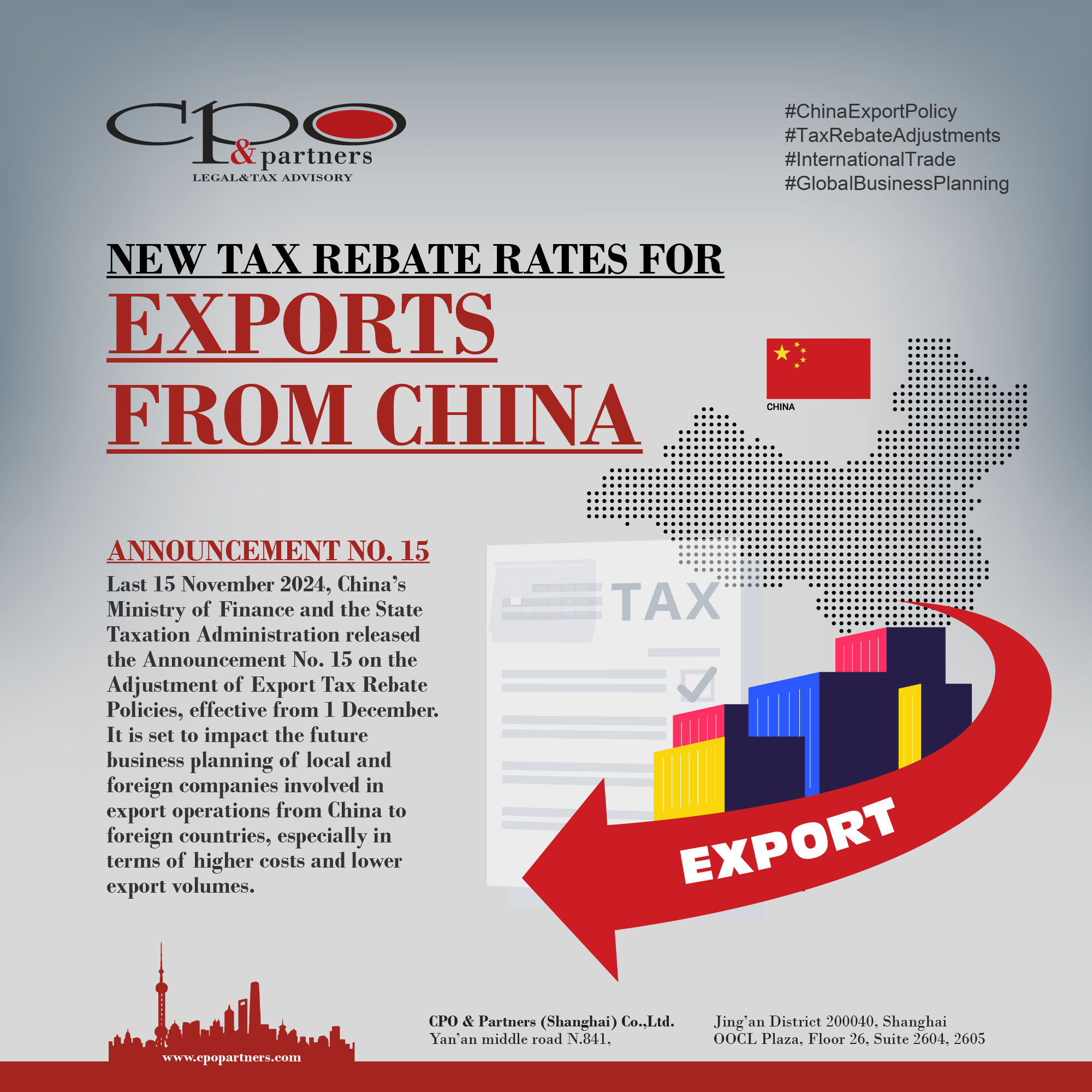
Last 15 November 2024, China’s Ministry of Finance and the State Taxation Administration released the Announcement No. 15 on the Adjustment of Export Tax Rebate Policies, effective from 1 December. It is set to impact the future business planning of local and foreign companies involved in export operations from China to foreign countries, especially in terms of higher costs and lower export volumes.

Two different sets of adjustments were introduced on China’s export tax rebate, incentive system started in 1985 through which refunds are given to exporters on VAT and consumption tax (CT) paid before the export of their products abroad. The first set provides for the cancellation of the tax rebate on 59 items, including copper and aluminium products (plates, sheets, bars etc.), chemically modified oils and fats, and other kinds of metals.
The second set includes a reduction of the VAT rebate rate from 13% (which entailed a full refund of VAT on purchases, being 13% in China) to 9% for 209 items. Refined oils, batteries, photovoltaic products are among the affected categories.
Seen since its inception as a strategic policy to improve the competitiveness of exported goods in the international market, the VAT Tax Rebate (出口退税) system allows exporters to recover VAT on goods intended for export, receiving the VAT paid on purchases (in full or in part, based on the specific VAT refund percentage defined for each customs code) directly into the company bank account, in a relatively short time (1-2 months) from the submission of the necessary documentation relating to export. The Tax Rebate system is applicable both to companies that carry out trading activities and to the manufacturing companies, with different application rules.
Nuovo Accordo Italia-Cina Doppia Imposizione fiscale

New Italy-China Double Taxation Agreement soon in force

Nuovo Accordo Italia-Cina Doppia Imposizione fiscale

New Italy-China Double Taxation Agreement soon in force

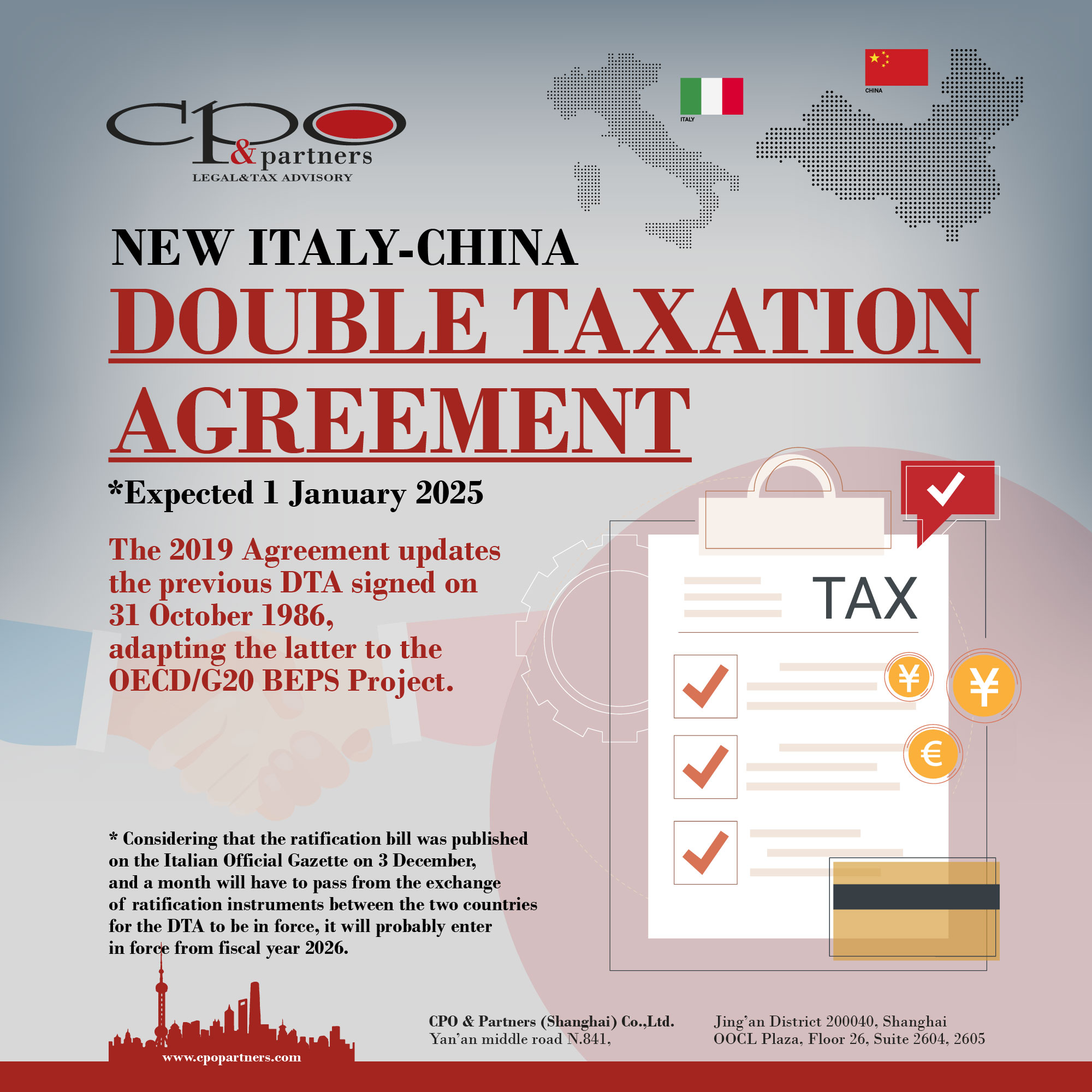
On 5 November 2024, the Italian Chamber of Deputies approved the bill for the ratification and execution of the Double Taxation Agreement (DTA) signed in 2019 between the governments of the Italian Republic and the People’s Republic of China regarding income taxes double taxation and the prevention of tax evasion and avoidance. With the Meloni government taking office in October 2022, the bill had to obtain a new approval by the Italian Council of Ministers, and subsequently underwent Parliament discussion. The Agreement will enter into force following the exchange of ratification instruments between the contracting countries, expected by 1 January 2025.

The 2019 Agreement updates the previous DTA signed on 31 October 1986, adapting the latter to the OECD/G20 BEPS Project.
Among the revisions, Article 10 provides for a reduced withholding tax rate from 10% to 5% in relation to dividends from investments participated for at least 25% of the capital, and continuously for 365 days.
Article 11 regulates interests, providing for a reduction to 8% for interests paid to financial institutions for 3 years minimum duration loans aimed at investment projects.
Finally, Article 12 confirms a standard rate at 10% for royalties, with a reduction to 5% for royalties on industrial, commercial or scientific equipment.
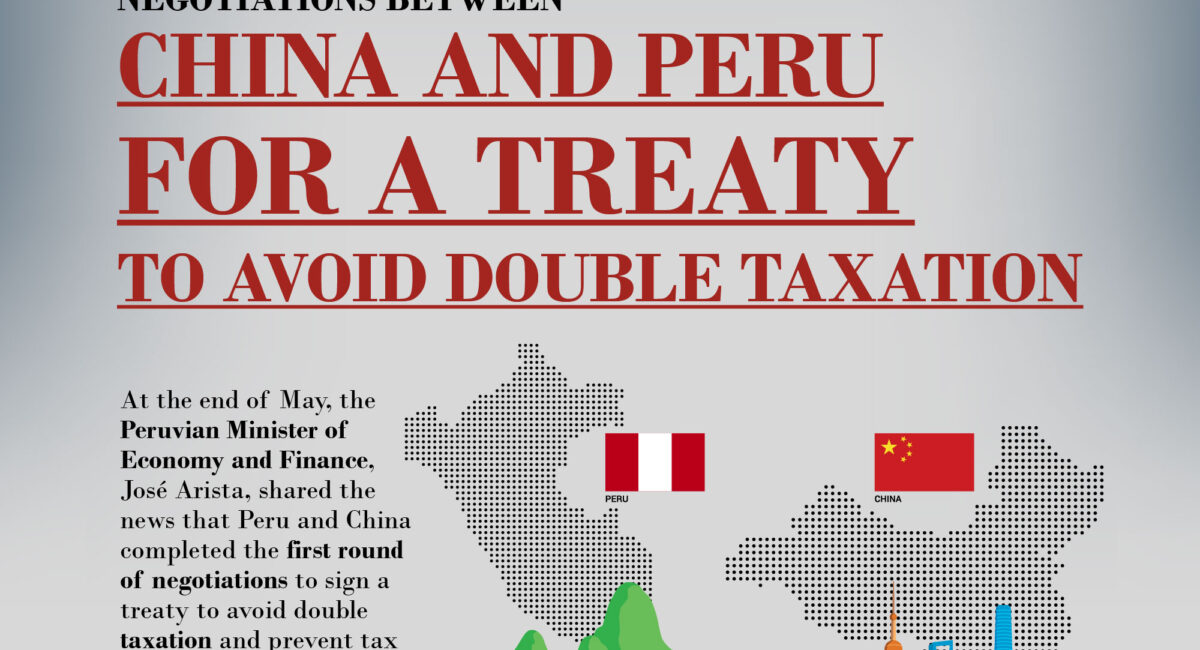
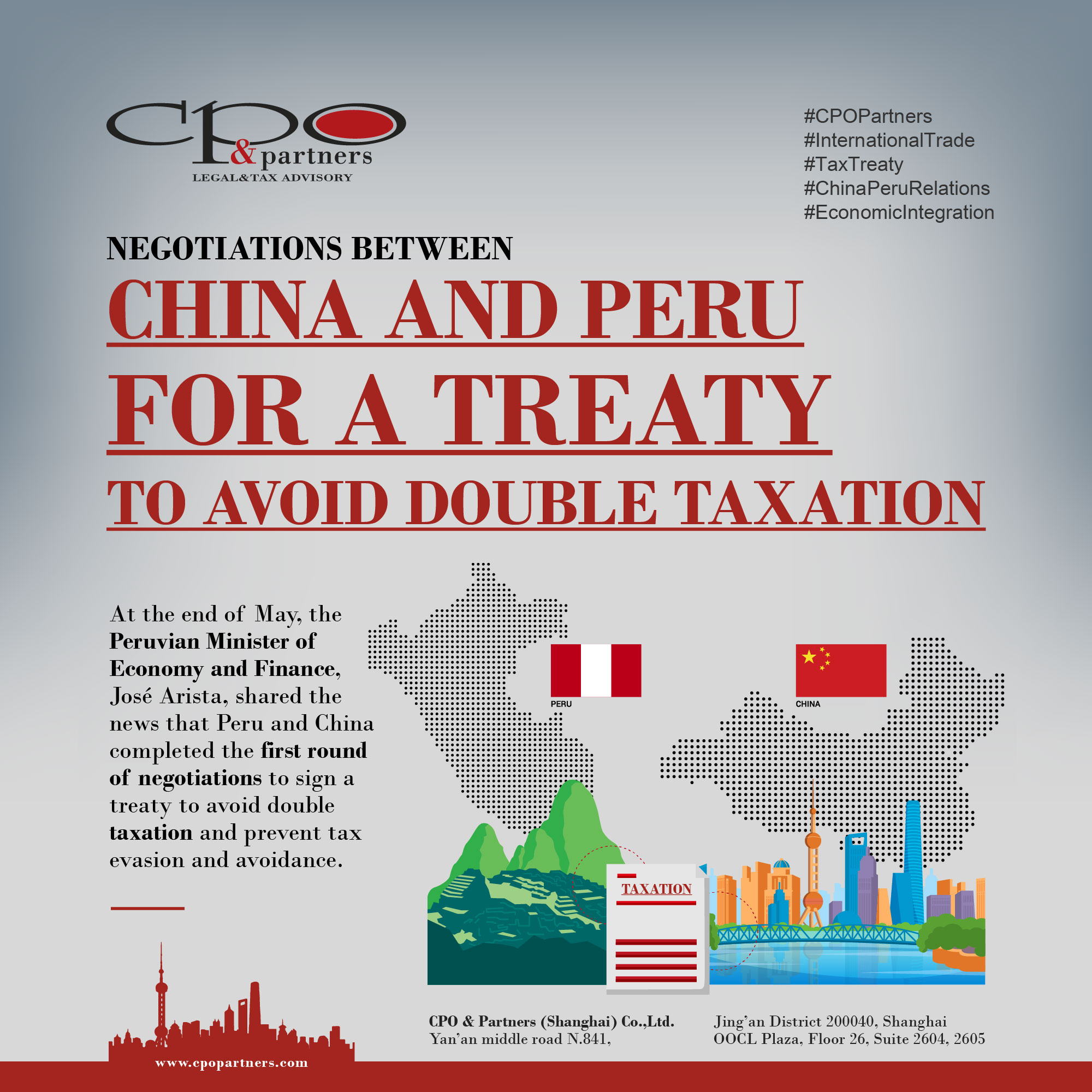
to avoid double taxation

Negociaciones entre China y Perú

to avoid double taxation

Negociaciones entre China y Perú para un Tratado que evite la doble tributación

A finales de mayo, el ministro peruano de Economía y Finanzas, José Arista, comunicó la noticia de que Perú y China habían concluido la primera ronda de negociaciones para suscribir un tratado destinado a evitar la doble tributación y prevenir la evasión y elusión fiscal. Se espera que en noviembre de este año se inicie una segunda ronda, que podría culminar con la firma y ratificación definitiva entre las partes. El acuerdo afectará a los ámbitos del comercio de bienes y servicios y de las inversiones, alcanzando una mayor integración entre las respectivas economías. El tratado previsto señala la importancia del mercado peruano para China, considerando que la nación asiática es el primer destino de las exportaciones peruanas, por un monto de 23 mil millones de dólares en 2023. En los últimos años, China también ha mostrado interés en invertir en el país, especialmente en los sectores de minería, energía y transporte. El nuevo acuerdo reforzará el marco jurídico institucional ya existente entre China y Perú, que firmaron un Tratado de Libre Comercio en abril de 2009.
Update of the double taxation Agreement between the Italian and Chinese governments

Update of the double taxation Agreement

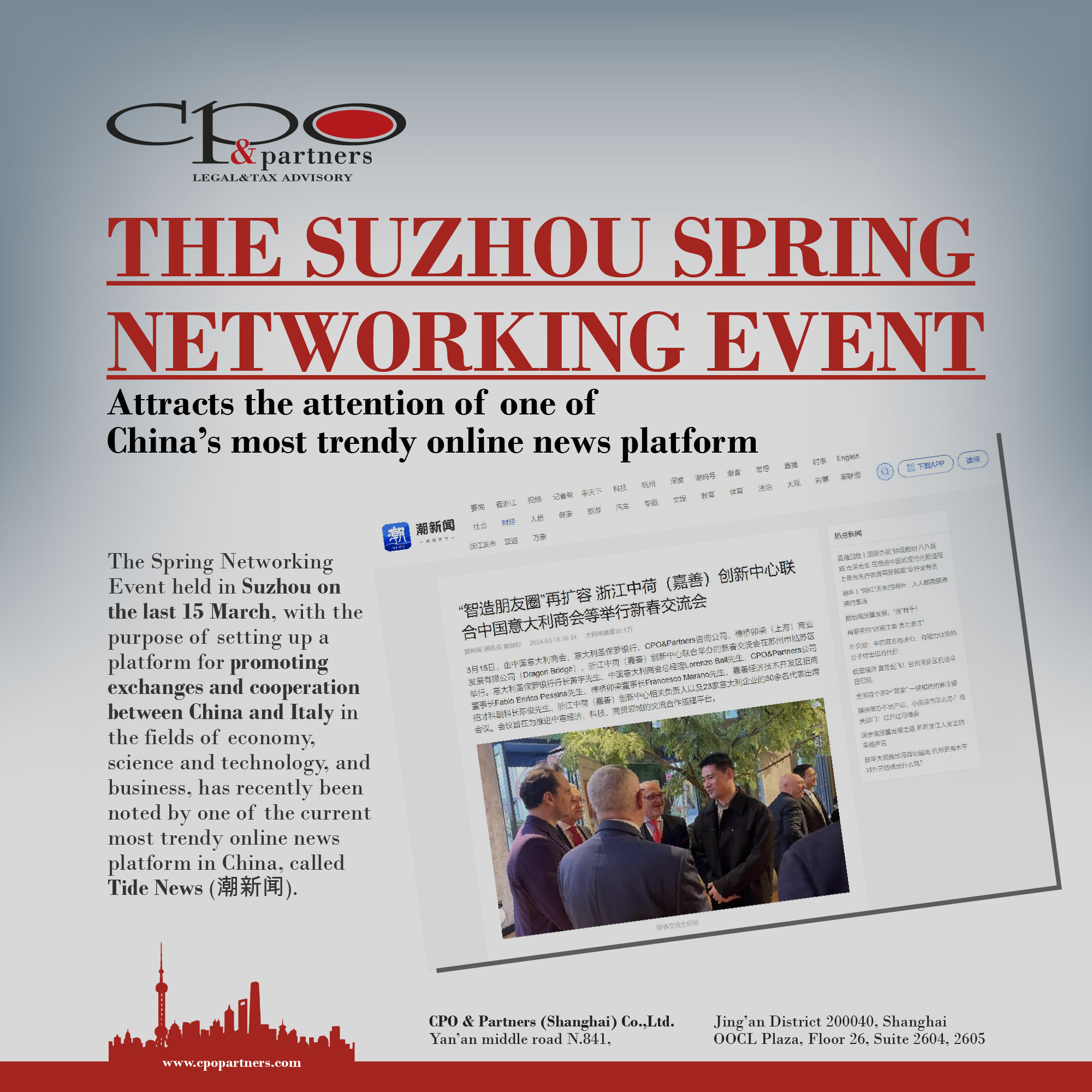
The Suzhou Spring Networking Event

Update of the double taxation Agreement between the Italian and Chinese governments

On 15 April 2024 the Council of Ministers, upon the proposal of the Minister of Foreign Affairs and International Cooperation, Antonio Tajani, approved a bill for the ratification and execution of a previous Agreement stipulated with the government of the People’s Republic of China regarding double taxation with respect to income taxes and the prevention of tax evasion and avoidance.

The text approved on 15 April updates the already existing Agreement signed between the two States on 31 October 1986, in order to adapt the legislation to the recommendations of the OECD/G20 BEPS (Base Erosion and Profit Shifting) project.

The updated Agreement applies to residents of the contracting States, and for Italy in particular relates to IRPEF, IRES and IRAP taxes, by setting general and subsidiary criteria through which defining a person as “resident of a Contracting State”, and by clarifying the cases in which a “permanent establishment” is involved.

The approved text regulates specific topics related to the double taxation issue, among which there are: taxability of real estate income, which must be taxed in the State in which the real estate that represents the income source is located (albeit in a non-exclusive manner); the treatment of business profits, as well as profits deriving from the operation, in international traffic, of ships or aircrafts; taxation rules for capital income regarding dividends, interest, royalties and capital gains; distribution of taxation in the two contracting States in relation to: independent professions, subordinate work, members of management and supervisory boards, remuneration from artistic and sporting activities, as well as sums received as pensions or for other public functions performed; the criterion of exclusive taxation in the State of residence for any other residual type of non-mentioned income; the methods for eliminating double taxation, in accordance with the domestic legislation of each contracting State; anti-abuse provisions, the principle of non-discrimination, the mechanism of the amicable procedure for the resolution of disputes, and the exchange of information between the two States.
This initiative signals the intention of both governments to improve the condition of Italian companies operating in China and to give more certainty to Chinese investors interested in or already engaged with the Italian business environment.