CPO & Partners at CIIE 2025, Shanghai
Once again this year, the CPO & Partners team attended the China International Import Expo (CIIE) in Shanghai — one of the world’s key events for trade and innovation.

China: more open, more connected – Visa free policy 31 dicembre 2026

China: more open, more connected
The visa-free transit policy has been expanded to 240 hours – now valid in 65 ports in 24 provinces – and extended until 31 December 2026 (was expiring on 31 December 2025) the policy of exemption from visa with possibility of entry in China Mainland without visa for a period of 30 days, for over 40 countries, among which France, Germany, Italy, Netherlands and Spain, with Sweden that will be added to the list starting from 10 November.
A strong signal of the country’s commitment towards facilitating international mobility, strengthening global connectivity, and supporting inbound tourism and business exchanges.

Zilmet Jiaxing Grand Opening

Zilmet Jiaxing Grand Opening
On October 29th, 2025, the new Zilmet Jiaxing Plant officially opened in the Jiaxing Nanhu High-Tech Zone, marking an important milestone for the Italian group UGO BENETTOLO S.p.A. and for the strengthening of industrial cooperation between Italy and China.
The new facility, covering 15,000 square meters and built with a total investment of USD 45 million, is equipped with advanced production lines for expansion tanks and plate heat exchangers, reinforcing Zilmet’s position as a global leader in high-end pressure vessel manufacturing.
The opening ceremony was attended by Zilmet Group President Paolo Benettolo, Zilmet Jiaxing Executive Director Marco Gottardello, Consul General of Italy in Shanghai Tiziana D’Angelo, institutional leaders from Jiaxing City and Nanhu District, and representatives from leading companies such as Bosch, Haier and Vanward.
CPO & Partners, which has supported Zilmet throughout its establishment and operations in China, is proud to share this important achievement and to continue assisting Italian companies in their international expansion projects.
Congratulations to Zilmet for this new chapter of growth and innovation in China.

Italy Monza Event – Industrial Park Zhaoqing

Italy Monza Event – Industrial Park Zhaoqing
The delegation of the Zhaoqing Industrial Park presented its investment opportunities at the Sporting Club in Monza, during a meeting that brought together Italian entrepreneurs and companies interested in strengthening ties with China.
The event concluded with a buffet dinner, providing a valuable occasion for networking and direct exchange between the Chinese delegation and Italian business representatives.
An initiative that highlights the importance of dialogue and international cooperation, opening new perspectives for collaboration between the two countries.

Zhaoqing Delegation visiting CPO & Partners

Zhaoqing Delegation visiting CPO & Partners
On September 23rd, 2025, the delegation of the Zhaoqing Industrial Park visited the Italian headquarters of CPO & Partners in Monza and later the ICCF office in Milan, on the occasion of the presentation of the opportunities offered by their industrial park.
An important exchange fostering dialogue between Italy and China and opening new perspectives for international cooperation.

China Labor Compliance and High-Temperature Allowance

China Labor Compliance and High-Temperature Allowance
With increasing extreme summer temperatures in China, employers must implement measures to protect employees from heat-related health risks, including both physical safeguards and compliance with high-temperature allowance regulations. High-heat labor protection is governed by national legislation and local implementation rules, which determine allowance amounts, calculation methods, and applicable months for each province.
The law provides for a cash allowance based on specific heat conditions: for outdoor work a temperature equal or higher than 35°C, for indoor work a temperature equal or higher than 33°C with insufficient cooling. The cash allowance cannot be substituted with benefits like cold drinks, is subject to personal income tax, and is eligible for all staff, including interns, dispatch, temporary, hourly workers and foreigners under Chinese labor contracts.
Other employer duties include rescheduling working hours to avoid peak heat, providing cooling and protective measures (cooling devices, rest areas, cold water, PPE) and planning training sessions and health checks. Summer inspections by labor bureaus may occur and violations may lead to fines, retroactive worker compensation, and reputational damage.

Shanghai’s Plan to Improve the Tax Refund Environment for Departing Visitors

Shanghai’s Plan to Improve the Tax Refund Environment for Departing Visitors
On July 3, 2025, the Shanghai Municipal Commission of Commerce, together with five departments, launched a 2025–2027 Action Plan to upgrade its departure tax refund system. The new policy allows foreign tourists to receive VAT refunds directly in-store through the “Refund-upon-Purchase” system, replacing the previous departure-based tax refund system. Foreign tourists shopping at eligible stores need to complete a refund agreement and credit card pre-authorization to receive an instant refund. At departure, they present goods, receipts, and ID to customs for verification. Lastly, a refund agency at the port finalizes the process.
In addition, the minimum spending threshold was reduced from ¥500 to ¥200 per store per day, while the daily refund cap rose to ¥20,000. Moreover, to encourage merchant adoption, Shanghai offers up to 50% equipment subsidies, cash incentives (¥5,000–¥10,000), and fee waivers for up to two years. Moreover, registration has been simplified, and credit requirements relaxed to include Grade M taxpayers.
Shanghai plans to boost over 80% of tax-refund stores to support instant refunds via card or mobile payment. Furthermore, it aims to expand to 3,000+ stores and 10,000 service points by 2027, with smart terminals, sealed-bag packaging, and multilingual tools improving efficiency.

China 2025–2028 Tax Credit Policy

China 2025–2028 Tax Credit Policy for Foreign Investors’ Reinvestment of Profits
On 27 June 2025, China’s Ministry of Finance, State Taxation Administration, and Ministry of Commerce jointly issued Announcement [2025] No. 2, regarding a 10% enterprise income tax credit that can be claimed by eligible foreign investors who reinvest profits (e.g., dividends, interest, royalties or other kind of income) in specified sectors. The policy applies from 1 January 2025 to 31 December 2028, with retroactive eligibility for qualifying investments made after 1 January 2025.
To qualify, reinvestments must be in industries listed in the Encouraged Industries Catalogue and take the form of capital increases, new enterprises, or equity acquisitions from unrelated, non-listed parties. Among those Encouraged Industries are agriculture, mining, manufacturing, construction, transport, IT, finance, R&D and others. The holding period of investment must be at least five years, and investments must be paid directly from the distributing enterprise to the investee. In addition, early withdrawal triggers tax repayment and proportional claw back of tax credits, and compliance is managed through the Ministry of Commerce’s Unified Platform.
China’s new VAT Law takes effect in 2026
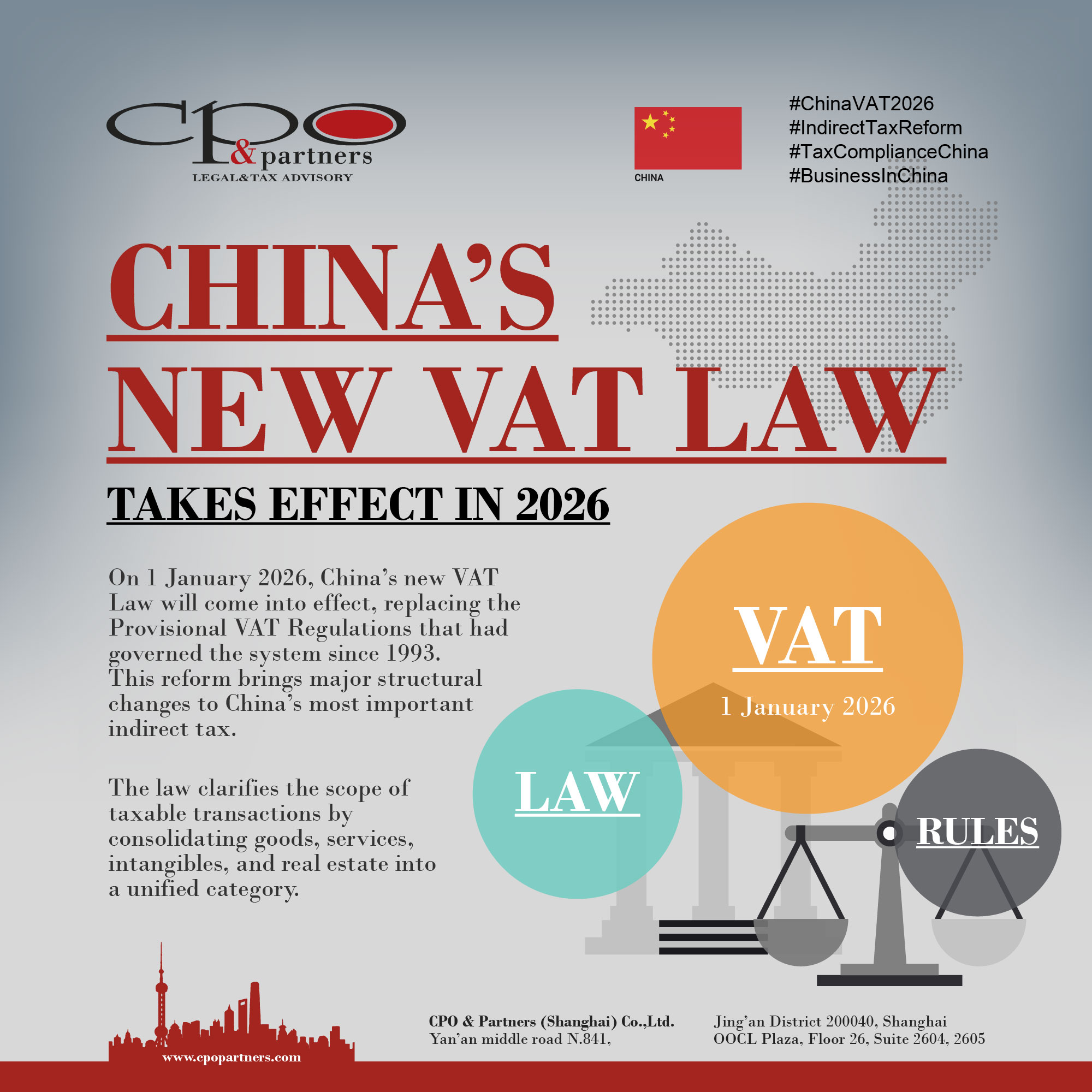
China’s new VAT Law takes effect in 2026
On 1 January 2026, China’s new VAT Law will come into effect, replacing the Provisional VAT Regulations that had governed the system since 1993. This reform brings major structural changes to China’s most important indirect tax.
The law clarifies the scope of taxable transactions by consolidating goods, services, intangibles, and real estate into a unified category. The previous distinction for “labor services” has been removed and is now treated as part of “services.”
Provisions on deemed sales have been updated. Self-produced or commissioned goods provided for non-business use, such as employee benefits, will now be taxable. Free intra-group services between businesses will no longer be subject to VAT.
Rules on input VAT deductions have also changed. Loan service VAT may become deductible; however, this depends on implementing rules to be issued by the State Council.
For small-scale taxpayers, a simplified structure introduces a unified 3% rate, replacing the previous 3% and 5% tiers. Some exceptions may apply, for example in real estate leasing.
The law also introduces anti-avoidance rules allowing tax authorities to adjust valuations in non-monetary or related-party transactions. In addition, taxpayers may either carry forward excess input VAT or apply for a refund, improving liquidity.

CPO & Partners at the ICG European & Asia Integration Meeting – Madrid, 8 July 2025