Nuovo Accordo Italia-Cina Doppia Imposizione fiscale

New Italy-China Double Taxation Agreement soon in force

Nuovo Accordo Italia-Cina Doppia Imposizione fiscale

New Italy-China Double Taxation Agreement soon in force

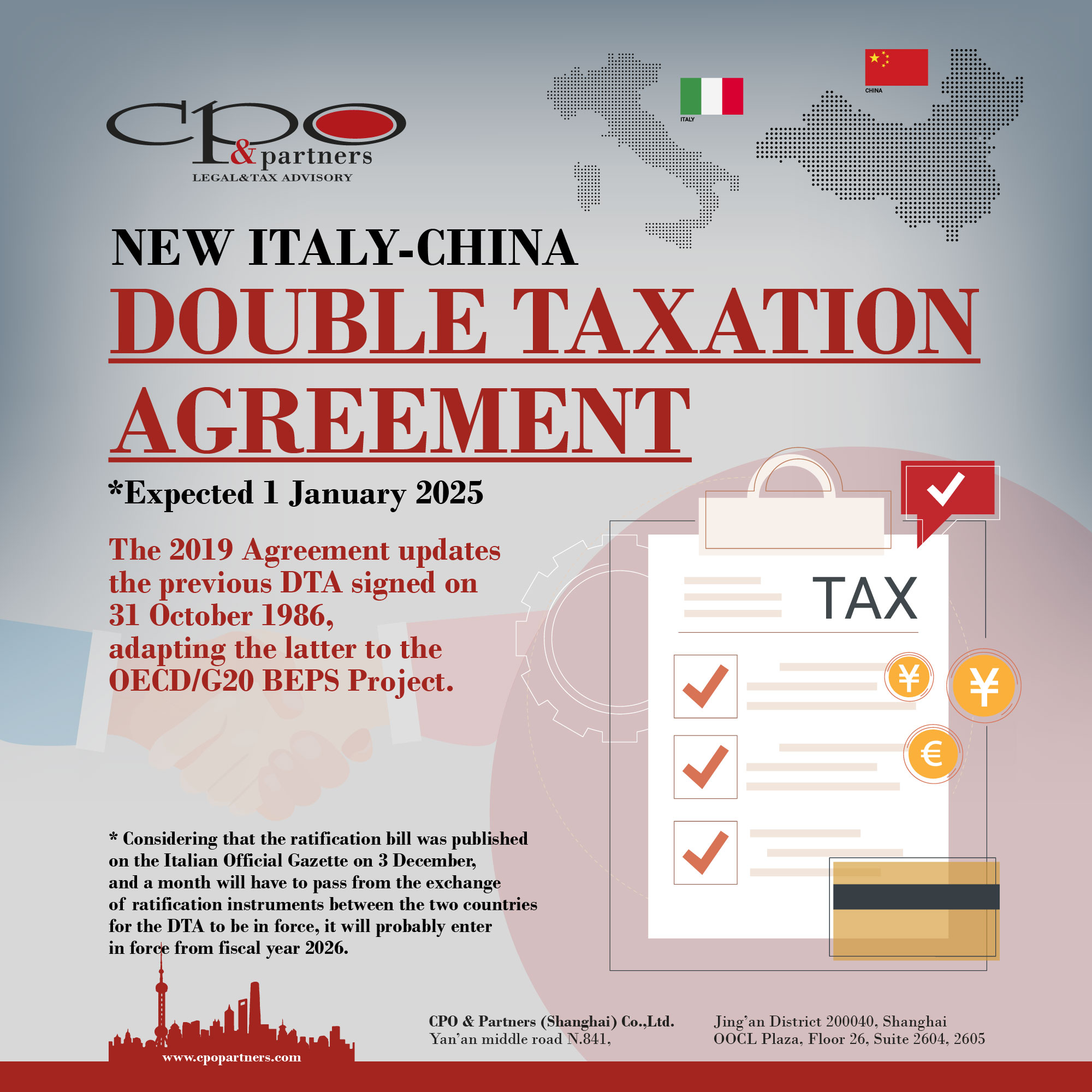
On 5 November 2024, the Italian Chamber of Deputies approved the bill for the ratification and execution of the Double Taxation Agreement (DTA) signed in 2019 between the governments of the Italian Republic and the People’s Republic of China regarding income taxes double taxation and the prevention of tax evasion and avoidance. With the Meloni government taking office in October 2022, the bill had to obtain a new approval by the Italian Council of Ministers, and subsequently underwent Parliament discussion. The Agreement will enter into force following the exchange of ratification instruments between the contracting countries, expected by 1 January 2025.

The 2019 Agreement updates the previous DTA signed on 31 October 1986, adapting the latter to the OECD/G20 BEPS Project.
Among the revisions, Article 10 provides for a reduced withholding tax rate from 10% to 5% in relation to dividends from investments participated for at least 25% of the capital, and continuously for 365 days.
Article 11 regulates interests, providing for a reduction to 8% for interests paid to financial institutions for 3 years minimum duration loans aimed at investment projects.
Finally, Article 12 confirms a standard rate at 10% for royalties, with a reduction to 5% for royalties on industrial, commercial or scientific equipment.
Stronger cooperation between China and Spain

Stronger cooperation between China and Spain

Stronger cooperation between China and Spain

Despite the ongoing conflicts over state subsidies and other trade-related issues between the European Union and the People’s Republic of China, in 2024 Beijing proved his willingness to foster and improve its trade relations with many European countries. Among them, Spain has been active in recent years towards strengthening the bilateral exchanges with China, as proved last month when Spanish Prime Minister Pedro Sánchez hold an official visit in the Asian country on 8-11 September.

As China’s fifth-largest trading partner within the EU, Spain has all the interest in promoting mutual openness in the trade environment between the two countries, with a total trade volume that in 2023 reached USD 48.58 billion. The economic ties were strengthened during recent years with a series of agreements, among which a Bilateral Investment Treaty (BIT) in force since 2008, a Double Tax Avoidance Agreement (DTA) in force since 2021, and a Social Insurance Agreement, effective since 2018 , this latter is an agreement that for example other European Nations, as Italy, do not have with China. One of the purposes of Sánchez’s visit was to reinforce mutual investments in a different variety of sectors: in this direction goes the deal, announced by the Spanish delegation and worth one billion dollars, signed with the Chinese Envision Group to build a new hydrogen equipment factory in Spain.
New opening up in China’s healthcare sector

New opening up in China’s healthcare sector

New opening up in China’s healthcare sector
On 8 September, the Ministry of Commerce (MOFCOM) of the People’s Republic of China published the Circular No. 568, concerning the establishment of Wholly Foreign-Owned hospitals in selected pilot cities, namely Beijing, Tianjin, Shanghai, Nanjing, Suzhou, Fuzhou, Guangzhou, Shenzhen, and the island of Hainan. This move represents a further development in the process of opening up the country’s health sector to foreign investments, following a similar pilot project that in 2014 introduced the possibility of establishing Wholly Foreign-Owned hospitals. However, due to the stringent requirements imposed on them, the 2014 project mainly prompted foreign investors to channel their resources towards setting up hospitals through Joint Ventures and cooperation agreements with Chinese companies. The new Circular, which do not cover the Chinese traditional medicine field and the mergers and acquisitions of public hospitals, could become a great source of attractiveness for investments in a market of increasing importance, considering the healthcare needs of the rapidly aging Chinese population. To evaluate the effective potential of the new Circular it will be necessary to wait for the specific conditions and requirements, which will be announced separately.
Update of the double taxation Agreement between the Italian and Chinese governments

Update of the double taxation Agreement

The Suzhou Spring Networking Event

Update of the double taxation Agreement between the Italian and Chinese governments

On 15 April 2024 the Council of Ministers, upon the proposal of the Minister of Foreign Affairs and International Cooperation, Antonio Tajani, approved a bill for the ratification and execution of a previous Agreement stipulated with the government of the People’s Republic of China regarding double taxation with respect to income taxes and the prevention of tax evasion and avoidance.

The text approved on 15 April updates the already existing Agreement signed between the two States on 31 October 1986, in order to adapt the legislation to the recommendations of the OECD/G20 BEPS (Base Erosion and Profit Shifting) project.

The updated Agreement applies to residents of the contracting States, and for Italy in particular relates to IRPEF, IRES and IRAP taxes, by setting general and subsidiary criteria through which defining a person as “resident of a Contracting State”, and by clarifying the cases in which a “permanent establishment” is involved.

The approved text regulates specific topics related to the double taxation issue, among which there are: taxability of real estate income, which must be taxed in the State in which the real estate that represents the income source is located (albeit in a non-exclusive manner); the treatment of business profits, as well as profits deriving from the operation, in international traffic, of ships or aircrafts; taxation rules for capital income regarding dividends, interest, royalties and capital gains; distribution of taxation in the two contracting States in relation to: independent professions, subordinate work, members of management and supervisory boards, remuneration from artistic and sporting activities, as well as sums received as pensions or for other public functions performed; the criterion of exclusive taxation in the State of residence for any other residual type of non-mentioned income; the methods for eliminating double taxation, in accordance with the domestic legislation of each contracting State; anti-abuse provisions, the principle of non-discrimination, the mechanism of the amicable procedure for the resolution of disputes, and the exchange of information between the two States.
This initiative signals the intention of both governments to improve the condition of Italian companies operating in China and to give more certainty to Chinese investors interested in or already engaged with the Italian business environment.
Knowledge sharing on new business regulations for investment projects

Knowledge sharing on new business regulations for investment projects

Knowledge sharing on new business regulations for investment projects

The business regulatory environment in China is in constant evolution, prompting local administrations to understand, manage, and carry out the new regulations issued at the national and provincial level, a task that can be burdensome due to the complexity of the matters involved. Recently, the Shanghai Municipality issued the «Shanghai Action Plan to Adhere to Benchmark Reform and Continuously Create a World-Class Business Environment», whose main intent is to reach a greater optimization of the business environment in China, so as to attract top-quality domestic and international companies.

As a legal and tax consultancy firm with a solid footprint in Shanghai, CPO & Partners went to visit the Jing’an Administrative Service Center to have a meeting with the district administration on the new policies for investment projects found in the «Shanghai Action Plan».
This represents a precious opportunity for CPO & Partners to make inroads into the local regulatory environment, a task that can sometimes be challenging due to language and cultural differences that can create communication hindrances and reduce the exchange benefits. Moreover, dealing with the district authorities is a good way to network with local offices and understand their functioning, in the belief that only by properly knowing the administrative system one can accurately provide consultation, in order to reach a win-win outcome that is advantageous for both parties.