Negotiations between China and Peru
Negotiations between China and Peru for a Treaty to avoid double taxation
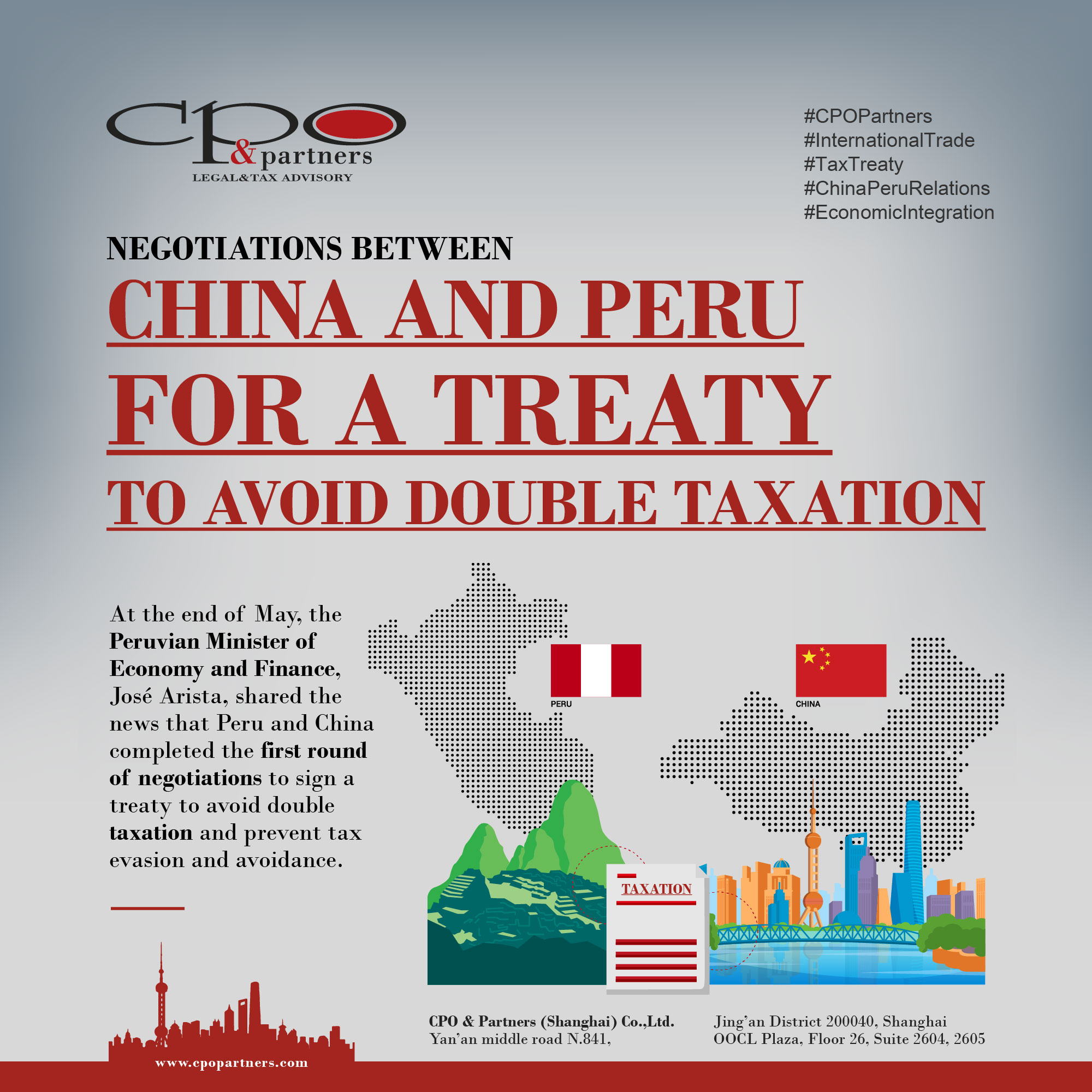
At the end of May, the Peruvian Minister of Economy and Finance, José Arista, shared the news that Peru and China completed the first round of negotiations to sign a treaty to avoid double taxation and prevent tax evasion and avoidance. A second round is expected to start in November of this year, which could lead to the final signing and ratification between the parties. The agreement will touch upon the fields of trade in goods and services and of investments, by reaching a greater integration between the respective economies. The planned treaty signals the importance of the Peruvian market for China, considering that the Asian nation is the first destination for Peru’s exports, for an amount of 23 billion dollars in 2023. In recent years, China has also been keen in investing in the country, especially in the mining, energy and transportation sectors. The new agreement will reinforce the legal institutional framework already existing between China and Peru, which signed a Free Trade Agreement in April 2009.

Shanghai, an action plan to facilitate payments for foreigners

The Shanghai Municipality promotes an action plan to facilitate payments for foreigners
The General Office of Shanghai Municipality has released the “Shanghai Action Plan to Further Improve Payment Convenience”, aiming to streamline payment procedures for foreign visitors coming to China.
The expected objectives will concern the following areas:
– Wider acceptance of foreign bank cards at key locations such as restaurants, supermarkets, pharmacies, hospitals, tourist attractions, hotels, transportation centers;
– An increase in the availability of ATMs from which it is possible to withdraw with foreign bank cards and the maintenance of cash payment channels, as well as a greater presence of foreign currency exchange points;
– The optimization of mobile payment services, facilitating the use of payments by “foreign-card bound” on the main local platforms (WeChat Pay, Alipay);
– The simplification of services relating to bank accounts for foreigners, from online appointment for account opening to the provision of multilingual services;
– The creation of dedicated areas in Pudong and Hongqiao airports and in star hotels, where visitors can purchase cards for city transport and exchange currency, receiving local currency even in small denomination;
– Greater communication activity, to promote the new measures to foreigners through the use of guides, promotional videos and dedicated consultancy structures.
The plan proposed by Shanghai is in line with the measures proposed for the entire Chinese national territory. The difficulty of making payments using foreign bank cards represents in fact another barrier, in addition to the linguistic and cultural ones, that visitors arriving in China face, making facilitation in this regard increasingly necessary.
https://www.shanghai.gov.cn/nw12344/20240430/17d55b402ea04e3eadb86983b1850681.html)